Clinical trials often involve participants across multiple countries and language groups. To support informed consent, participant safety, and reliable data collection, clinical trial documents must communicate the intended information clearly and accurately in every required language.
Back translation in clinical trials may be required when a study protocol, sponsor procedure, ethics committee or institutional review board (IRB), or applicable requirements specify it. It is commonly considered for informed consent forms, patient-reported outcome (PRO) measures, questionnaires, and other documents where differences in meaning could affect participant understanding or study data. However, back translation is not a universal requirement for every clinical trial document.
Understanding when back translation is appropriate and how it fits into a broader translation quality assurance process, helps research teams plan multilingual studies more effectively. MyTranscriptionPlace supports clinical research communication through professional translation services focused on accuracy, consistency, and confidentiality.
What Is Back Translation in Clinical Trials?
Back translation is a quality control method in which a document translated into a target language is independently translated back into its original language. Reviewers compare the back-translated version with the original source to identify potential differences in meaning, omissions, terminology, or interpretation.
For example, a clinical trial questionnaire written in English may be translated into Spanish for participants. A separate translator then translates the Spanish version back into English. The research team compares the two English versions to identify wording or conceptual differences that may require further investigation.
Back translation can help identify potential translation issues, but it does not independently prove that the target-language version is accurate, culturally appropriate, or easy for participants to understand. It should be used alongside other quality checks when required or appropriate.
Why Is Back Translation Important in Clinical Research?
Clinical trial translations must preserve the intended meaning of medical information across languages. Even a subtle wording difference can affect how participants interpret a question, understand a risk, or follow a study instruction.
Back translation can help research teams:
Identify potential changes in the meaning of translated content.
Review medical terminology and clinically significant wording.
Check the consistency of questionnaires and response options.
Identify possible discrepancies in participant instructions.
Support documented translation quality assurance.
Investigate differences that could affect the interpretation of clinical research data.
The appropriate review process depends on the document's purpose, the study population, the potential consequences of a translation error, and the applicable requirements.
When Is Back Translation Required in Clinical Trials?
Back translation may be required when specified by the study protocol, sponsor standard operating procedures (SOPs), ethics committee or IRB instructions, or other applicable requirements. It may also be selected as an additional quality control measure when a document contains information that must retain its intended meaning across languages.
Research teams should assess the need for back translation on a document-by-document basis rather than assuming that every clinical trial document requires the same process.
Common situations in which back translation may be considered include:
1. Informed Consent Forms
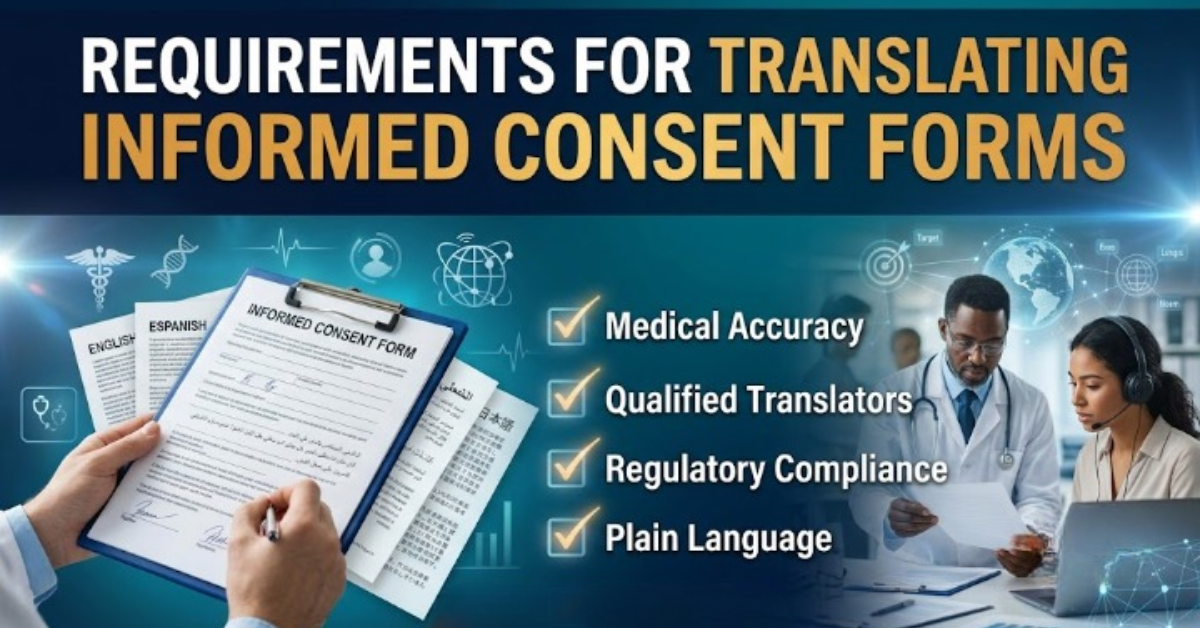
Informed consent forms explain the purpose of a clinical trial, study procedures, potential risks and benefits, participant rights, and other essential information.
Where required or appropriate, back translation can help reviewers identify discrepancies in how this information is communicated in the target language. The final translated document must undergo the appropriate review and approval process before use.
2. Patient-Reported Outcome Measures
Patient-reported outcome (PRO) measures collect information directly from participants about symptoms, functioning, quality of life, or treatment outcomes.
Translation differences can change the meaning of questions, symptom descriptions, or response scales. For PRO instruments, a suitable linguistic validation and cultural adaptation process may be necessary, depending on the instrument's requirements and intended use. Back translation may form part of that process.
3. Patient Questionnaires and Diaries
Questionnaires and patient diaries often rely on consistent wording and clearly defined response options. Back translation may help identify discrepancies that could affect how participants answer questions or report symptoms.
4. Patient Instructions and Study Materials
Instructions about medication schedules, study visits, sample collection, or other trial procedures must be understandable to the intended audience. Back translation may be useful where a study's requirements call for additional verification of the translated content.
5. Safety Information and Other Clinically Significant Documents
Documents containing information about risks, adverse events, eligibility, or other clinically significant matters may warrant additional translation review. The appropriate method should be selected according to the document's purpose and applicable requirements.
Important: These document categories do not automatically require back translation in every study. Sponsors and research teams should confirm the relevant requirements and select a suitable quality assurance procedure for each document.
Do the FDA and EMA Require Back Translation for Clinical Trials?
The U.S. Food and Drug Administration (FDA) and the European Medicines Agency (EMA) operate within regulatory frameworks that address clinical research, participant protection, and the quality of information used in relevant regulatory processes. However, it is important not to interpret these frameworks as a blanket requirement to back-translate every clinical trial document.
The need for back translation depends on the applicable requirements, document type, study protocol, sponsor procedures, and ethics committee or IRB expectations.
FDA Requirements for Clinical Trial Back Translation
The FDA does not universally require back translation for every clinical trial document. Research teams should identify the FDA requirements and guidance applicable to their specific study and document type, alongside any relevant IRB and sponsor requirements.
For informed consent materials, the focus should include whether participants receive the information needed to make an informed decision. Back translation may help identify discrepancies, but it does not replace the appropriate review and approval of the translated consent materials.
Official resource: U.S. Food and Drug Administration.
EMA Requirements for Clinical Trial Back Translation
EMA-related requirements should likewise be considered in the context of the applicable European clinical trial framework, the relevant national and ethics review procedures, and the study's documentation requirements.
Research teams should verify which translation and review procedures apply to the specific documents and jurisdictions involved. Back translation may be appropriate as part of the quality assurance plan, but it should not be assumed to be universally mandatory for all documents.
Official resource: European Medicines Agency — Clinical Trials.
How Should Research Teams Approach Regulatory Compliance?
Before commissioning a translation, research teams should:
Review the applicable regulations and current guidance.
Confirm sponsor SOPs and study protocol requirements.
Check relevant ethics committee or IRB instructions.
Identify which documents require back translation or other specific quality checks.
Document the translation and review procedures, decisions, and approvals as required.
This approach helps research teams establish a translation process that is appropriate for the study instead of relying on a single method for every document.
Which Clinical Trial Documents May Need Back Translation?
The need for back translation depends on the document's purpose, content, intended audience, and study requirements.
Not every document listed above necessarily needs back translation. Some may require independent linguistic review, reconciliation, cognitive debriefing, or another quality assurance method. The translation plan should reflect the study's actual requirements and the potential consequences of misunderstanding.
How Does the Clinical Trial Back Translation Process Work?
A structured workflow helps research teams identify discrepancies, resolve translation issues, and maintain appropriate records. The exact process varies according to the document type, sponsor procedures, and applicable requirements.
Step 1: Review the Source Document
Identify medical terminology, clinically significant wording, participant instructions, response scales, and concepts that must retain their intended meaning.
Step 2: Complete the Forward Translation
A qualified translator translates the original document into the target language, considering the document's purpose, intended audience, and relevant medical terminology.
Step 3: Conduct an Independent Back Translation
A separate translator translates the target-language version back into the source language. Ideally, this translator has not seen the original document, reducing the risk of unconsciously reproducing its wording.
Step 4: Compare the Versions
Review the original and back-translated documents to identify potential differences in meaning, missing information, terminology, instructions, and response options.
Step 5: Reconcile Discrepancies
The translation team and relevant study stakeholders investigate the differences and determine whether the target-language version needs revision. A difference in wording is not necessarily an error; the key question is whether the intended concept has been preserved.
Step 6: Complete Additional Quality Checks
Depending on the document, this may include expert review, proofreading, linguistic validation, cultural adaptation, or cognitive debriefing with members of the intended population.
Step 7: Finalise and Document the Translation
The final version should undergo the appropriate review and approval process. Maintain relevant translation versions, review comments, discrepancy resolutions, and approval records in accordance with the study's procedures.
Back translation is most useful when findings are reviewed systematically and any significant issues are addressed. Completing the back translation alone does not establish that the document is ready for clinical use.
Back Translation vs. Linguistic Validation
Back translation and linguistic validation are related but distinct processes. Both can contribute to the quality of translated clinical research materials, but they address different aspects of translation quality.
Can Back Translation Replace Linguistic Validation?
No. Back translation cannot replace linguistic validation when the latter is required.
For patient-reported outcome measures, linguistic validation may involve evaluating whether the translated questions are conceptually equivalent, culturally appropriate, and understandable to the intended population. Cognitive debriefing, where appropriate, can help establish how participants interpret the translated content.
The appropriate methodology should be determined by the instrument's requirements, intended use, and study procedures. Professional good-practice recommendations, including those published by ISPOR, provide useful guidance for translating and culturally adapting PRO measures.
What Factors Determine Whether Back Translation Is Needed?
Research teams should evaluate the following factors before choosing a translation quality assurance process.
Regulatory and Ethics Requirements
Check the applicable regulatory framework, ethics committee or IRB instructions, approval conditions, and study-specific requirements.
Sponsor Procedures and Study Protocol
Some sponsors specify translation workflows in their SOPs or protocols. Confirm whether independent back translation, reconciliation, or other checks are required.
Participant Safety and Informed Consent
Documents that communicate medical risks, participant rights, or important study procedures may warrant more extensive review because misunderstandings can have significant consequences.
Nature of the Clinical Trial Document
A patient questionnaire, consent form, patient diary, and internal administrative document may have different quality assurance needs. The review method should reflect the document's intended purpose.
Data Consistency Across Languages
Where translated questions or response scales contribute to clinical research data, the team should assess whether language differences could affect the interpretation or comparability of responses.
Target Population and Cultural Context
A grammatically correct translation may still contain expressions or concepts that are unfamiliar to the intended population. Cultural and linguistic review can help address these issues where necessary.
Common Back Translation Mistakes in Clinical Research
Even when a document has been back-translated, important quality issues may remain. Research teams should avoid these common mistakes.
1. Assuming every document requires back translation: Confirm the actual requirements instead of applying the same workflow to every file.
2. Using the same translator for both directions without appropriate independence: An independent back translator can help reveal discrepancies that may otherwise be overlooked.
3. Relying on literal word matching: A word-for-word match does not necessarily demonstrate conceptual equivalence or natural language use.
4. Skipping discrepancy reconciliation: Identified differences should be investigated and resolved, rather than simply noted in a review report.
5. Ignoring cultural context: Expressions, symptom descriptions, and response options may not carry the same meaning across populations.
6. Treating back translation as a guarantee of accuracy: Additional expert review, linguistic validation, or other quality checks may still be needed.
7. Failing to document translation decisions: Maintain appropriate records of revisions, review comments, approvals, and discrepancy resolutions in accordance with the study's procedures.
Clinical Trial Translation Quality Assurance Checklist
Before finalising multilingual clinical trial documents, research teams can use this general checklist to review their translation plan.
Confirm the applicable regulatory, ethics committee, IRB, and sponsor requirements.
Identify the documents and target languages covered by the translation plan.
Assign qualified translators with relevant language and medical or clinical research experience.
Determine whether independent back translation is required.
Review terminology, medical risks, participant instructions, and response options.
Resolve significant discrepancies through an appropriate review process.
Conduct linguistic validation or cognitive debriefing when required.
Proofread the final versions and check consistency.
Maintain records of reviews, revisions, decisions, and approvals as required.
This checklist is a general planning aid. It does not replace study-specific SOPs, an approved translation plan, or applicable regulatory and ethics requirements.
How MyTranscriptionPlace Supports Clinical Trial Translation
Clinical research depends on clear communication between research teams and participants who may speak different languages. Inaccurate or unclear translations can create misunderstandings, making a suitable translation and quality assurance process essential.
MyTranscriptionPlace offers professional translation services to support multilingual communication in clinical research. Our approach focuses on accurate terminology, consistency, confidentiality, and careful handling of clinical research documents.
Depending on your project's requirements, relevant materials may include:
Informed consent forms and participant information sheets.
Patient-reported outcome measures and questionnaires.
Patient diaries and study instructions.
Clinical research materials requiring consistent medical terminology.
Other documents used to communicate clinical trial information.
The appropriate translation and review process depends on your documents, target languages, intended audience, and applicable requirements. Where back translation or linguistic validation is required, these steps should be incorporated into the agreed workflow.
Planning a multilingual clinical trial? Contact MyTranscriptionPlace to discuss your clinical trial translation requirements and explore suitable language support for your research documents.
Conclusion
Back translation can be a valuable quality control method for clinical trial documents when required by study protocols, sponsor procedures, ethics committee or IRB instructions, or other applicable requirements. It can help research teams identify potential differences in meaning, but it does not automatically guarantee translation accuracy or regulatory compliance.
The most appropriate approach combines a clear understanding of study requirements with qualified translators, systematic review, discrepancy resolution, and additional quality checks where necessary. For patient-reported outcome measures, linguistic validation may also be essential.
By selecting a document-appropriate translation workflow and maintaining suitable quality records, research teams can support clearer communication with multilingual participants and more consistent clinical research documentation. MyTranscriptionPlace helps research teams explore professional clinical trial translation support tailored to their language and documentation needs.
Our Best Translation Services
English to Indonesian Translation | English to Spanish Translation | English to Italian Translation | English to Russian Translation | English to Danish Translation | English to Vietnamese Translation | English to Japanese Translation | English to Finnish Translation | English to Dutch Translation | English to Arabic Translation | English to Norwegian Translation | English to Greek Translation.
Frequently Asked Questions
1. When is back translation required in clinical trials?
Back translation is required when specified by applicable requirements, study protocols, sponsor procedures, or ethics committee or IRB instructions. It may also be used as an additional quality control measure for informed consent forms, patient-reported outcome measures, questionnaires, and other documents where differences in meaning could affect participant understanding or study data.
2. Does the FDA require back translation for clinical trials?
The FDA does not universally require back translation for every clinical trial document. Research teams should review the applicable FDA requirements and guidance, relevant IRB expectations, sponsor procedures, and the specific needs of the study before deciding which translation quality checks are appropriate.
3. Does the EMA require back translation for clinical trials?
Back translation should not be assumed to be universally mandatory for every document under the European clinical trial framework. Research teams should verify applicable European and national requirements, relevant ethics review procedures, and sponsor expectations for the specific study and document.
4. What is the difference between back translation and linguistic validation?
Back translation involves translating a target-language document back into the original language to identify potential discrepancies. Linguistic validation assesses whether the translated content preserves the intended concepts and is understandable to the target population. It may include translation review, reconciliation, cultural adaptation, and cognitive debriefing.
5. Who should perform clinical trial back translation?
Back translation should be performed by a suitably qualified translator with strong language skills and relevant medical or clinical research experience where appropriate. An independent back translator who has not seen the source text can help identify differences that might otherwise be missed.
6. Does back translation guarantee clinical translation accuracy?
No. Back translation can reveal potential discrepancies, but it cannot independently guarantee accuracy, cultural appropriateness, or participant comprehension. Expert review, reconciliation, linguistic validation, proofreading, and other quality checks may be necessary depending on the document and study requirements.
7. Can informed consent forms be used in clinical trials without back translation?
Whether an informed consent form requires back translation depends on applicable requirements, ethics committee or IRB instructions, sponsor procedures, and the study's quality assurance plan. The translated form must undergo the appropriate review and approval process before use.
8. What is the difference between forward translation and back translation?
Forward translation converts a document from its source language into the target language. Back translation converts the target-language version back into the source language so reviewers can compare versions and investigate potential differences in meaning.
9. What clinical trial documents may need back translation?
Documents that may require back translation include informed consent forms, patient-reported outcome measures, questionnaires, patient diaries, patient instructions, and selected safety-related materials. The actual requirements depend on the document's purpose, the study protocol, sponsor procedures, and applicable regulations.
10. Is linguistic validation necessary for every clinical trial document?
No. Linguistic validation is particularly relevant to patient-reported outcome measures and other instruments where conceptual equivalence and participant comprehension are important. Whether it is necessary depends on the instrument, intended use, study requirements, and applicable guidance.

Nishi Singh
(Content Writer & SEO Manager)
She is an SEO Manager with over 8 years of experience in marketing and content creation. She specializes in SEO, content strategy, and paid advertisements, helping website owners across SaaS, B2B businesses, and e-commerce platforms achieve measurable growth. With a strong focus on driving organic traffic and crafting impactful content, Nishi has established herself as a trusted expert in the digital marketing space. When she's not optimizing websites, she channels her energy into marathon running, embracing challenges both on and off the track.