Pharmaceutical translation services UK help pharmaceutical, biotechnology, clinical research and life sciences organisations communicate important information accurately across languages and markets. Unlike general business translation, pharmaceutical translation requires specialist knowledge of clinical, scientific, medical, and regulatory terminology.
From clinical trial protocols and informed consent forms to regulatory submissions, patient information leaflets, product labels and safety documentation, pharmaceutical content must be translated with close attention to terminology, context, numbers, units, formatting and intended audience.
The UK clinical research landscape has also evolved in 2026. The UK's amended Clinical Trials Regulations took effect on 28 April 2026, introducing significant changes to the clinical-trial framework. For organisations managing multilingual clinical research content, keeping translation workflows aligned with current requirements is increasingly important.
This guide explains what pharmaceutical translation is, which documents require translation, how clinical and regulatory translation works, the role of linguistic validation and localisation, how AI is changing pharmaceutical translation, how much translation may cost and how to choose a pharmaceutical translation company in the UK.
What Are Pharmaceutical Translation Services?
Pharmaceutical translation services specialise in translating pharmaceutical, clinical, scientific, regulatory and patient-facing content while preserving its technical meaning, terminology and intended purpose.
These services are used by pharmaceutical companies, biotechnology businesses, clinical research organisations, healthcare organisations and life sciences companies operating across multiple languages and markets.
Pharmaceutical translation may involve:
Clinical trial documentation
Regulatory submissions
Patient information materials
Product information
Pharmaceutical labels and packaging
Safety and pharmacovigilance documents
Scientific publications
Medical questionnaires
Investigator documentation
Standard operating procedures (SOPs)
Training and technical materials
Market research content
The translation process needs to consider more than individual words. The translator must understand the medical or pharmaceutical context, terminology, target audience, document purpose and relevant formatting requirements.
What Documents Need Pharmaceutical Translation?
Pharmaceutical companies may require translation at different stages of drug development, clinical research, regulatory approval, commercialisation and post-market activities.
Common pharmaceutical documents include:
A specialist pharmaceutical translation company UK can help organisations manage these different document types while maintaining terminology and quality across multilingual projects.
Pharmaceutical Translation vs Medical Translation: What's the Difference?
Pharmaceutical translation is a specialised area of medical and life sciences translation that focuses particularly on medicines, pharmaceutical development, clinical research, regulatory documentation and related content.
Medical translation is a broader category covering healthcare content such as:
Medical records
Diagnostic reports
Hospital documents
Medical research
Healthcare websites
Patient communications
Pharmaceutical translation can have a stronger focus on:
Drug development
Clinical trials
Regulatory submissions
Product information
Pharmaceutical manufacturing
Pharmacovigilance
Medication-related content
Pharmaceutical research
There is considerable overlap between the two fields, which is why organisations should select translators with experience relevant to the specific project rather than relying solely on general translation expertise.
Clinical Trial Translation Services in the UK
Clinical trial translation involves translating documents and materials used to plan, conduct, manage and communicate clinical research across different languages.
Clinical trial translation may include:
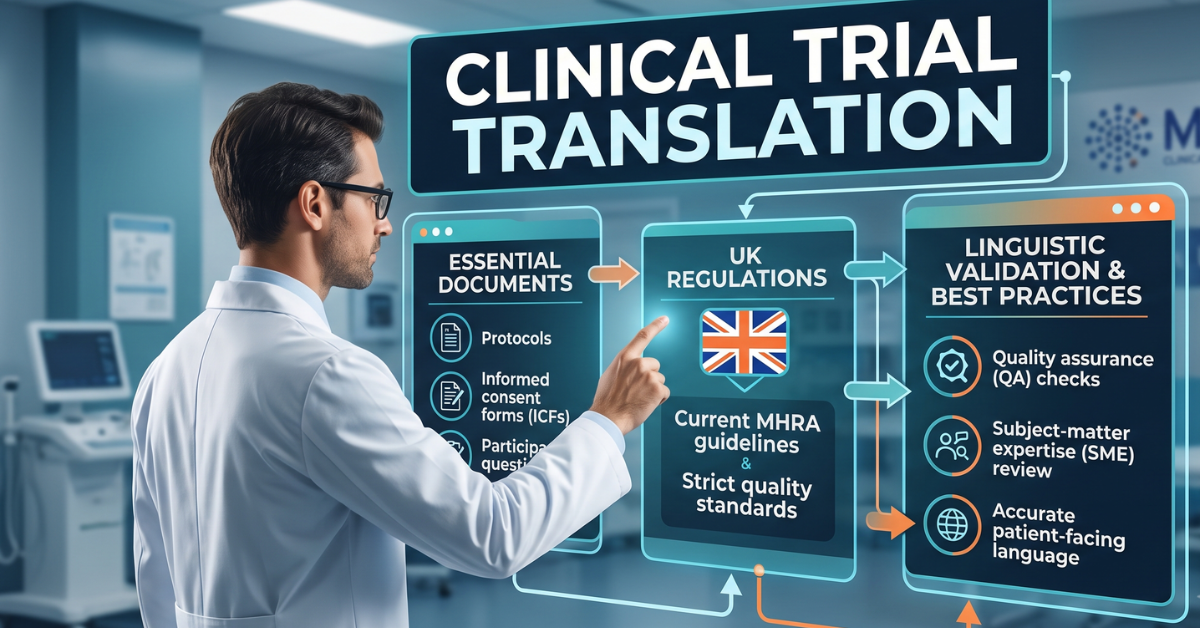
Clinical trial protocols
Participant information sheets
Informed consent forms
Patient questionnaires
Recruitment materials
Investigator documentation
Safety information
Clinical assessments
Trial-related correspondence
Participant-facing communications
The language used in clinical research needs to be technically accurate while remaining appropriate for its intended audience. A document intended for a clinical investigator may require different terminology and style from information intended for a trial participant.
UK Clinical Trial Translation in 2026
The UK's amended Clinical Trials Regulations came into force on 28 April 2026. The reforms represent a major update to the UK's clinical-trial framework and include changes relating to trial approvals, transparency, and the operation of clinical trials.
For pharmaceutical and clinical research organisations, this reinforces the importance of reviewing multilingual clinical-trial workflows against current UK requirements, rather than relying on outdated processes or pre-2026 guidance.
Translation requirements can vary depending on the trial, participant population, documentation and applicable regulatory and ethical requirements. Organisations should assess the language needs of their specific clinical-trial materials as part of their overall trial planning and compliance process.
Pharmaceutical Regulatory Translation
Pharmaceutical regulatory translation involves translating documents and information intended for regulatory authorities and other stakeholders involved in medicine approval, monitoring and compliance.
Regulatory translation can include:
Regulatory submissions
Product information
Labels
Packaging text
Patient information leaflets
Safety documentation
Regulatory correspondence
Clinical documentation
Pharmaceutical quality documentation
Regulatory content requires a high level of terminology consistency because even seemingly minor differences in wording can affect how information is understood.
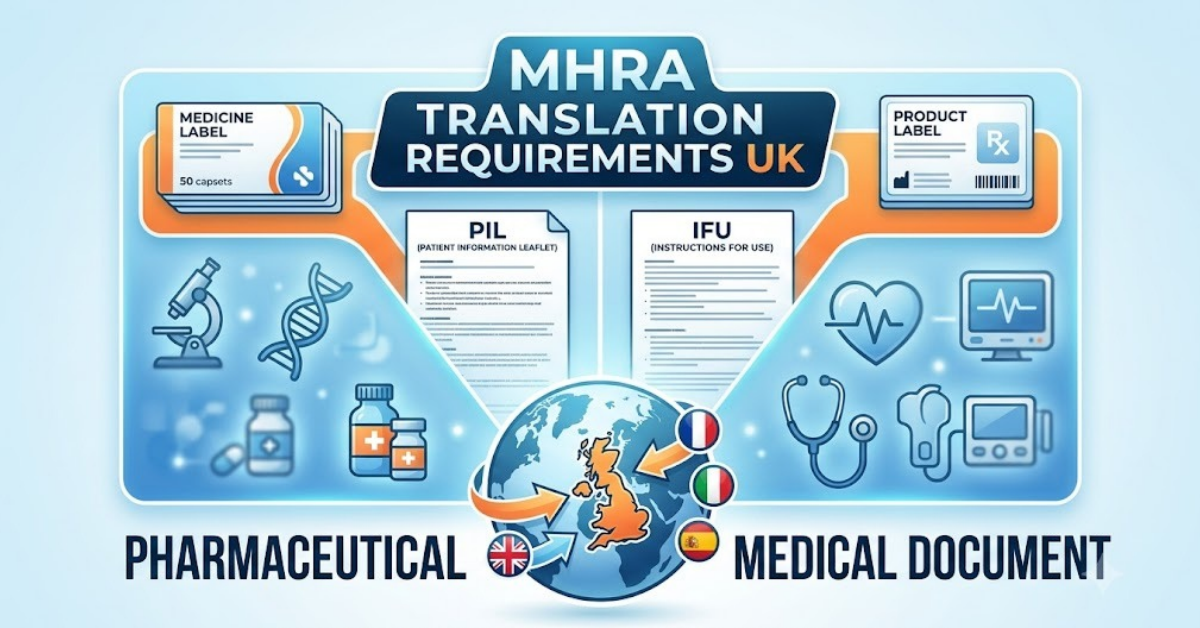
The UK's Medicines and Healthcare products Regulatory Agency (MHRA) provides requirements and guidance relating to medicines, including packaging, labelling and patient information leaflets. Pharmaceutical organisations should therefore ensure that their translation processes are aligned with the applicable requirements for their products and markets.
What Is Linguistic Validation in Pharmaceutical Translation?
Linguistic validation is a quality process used to confirm that translated content communicates the intended meaning clearly and appropriately to the target population.
It is particularly relevant to patient-facing and clinical materials, including:
Patient questionnaires
Clinical outcome assessments
Patient-reported outcome measures
Informed consent materials
Clinical trial questionnaires
Healthcare assessments
Linguistic validation goes beyond checking whether a translation is grammatically correct.
A typical process may consider:
Conceptual equivalence
Terminology
Clarity
Readability
Cultural appropriateness
Consistency
Target-audience comprehension
For pharmaceutical and clinical research organisations, this can help ensure that translated patient-facing content conveys the same intended concepts as the source material.
Pharmaceutical Localisation vs Translation
Pharmaceutical localisation adapts translated content for a specific target market, audience or language environment while preserving the intended scientific and pharmaceutical meaning.
Translation primarily focuses on transferring meaning between languages. Localisation may additionally consider:
Market-specific terminology
Units of measurement
Date and number formats
Formatting conventions
Cultural considerations
Patient readability
Target-market expectations
Regulatory considerations
Translation vs Localisation
For pharmaceutical content, localisation should never compromise the scientific or regulatory meaning of the original material.
Why Is Terminology Management Important in Pharmaceutical Translation?
Terminology consistency is essential in pharmaceutical translation because the same medicine, active ingredient, medical condition, procedure or instruction may appear across multiple documents.
For example, a pharmaceutical company may translate:
Clinical trial documents
Product information
Safety reports
Patient information
Regulatory documents
If the same technical term is translated differently across these documents without a valid reason, it can create confusion and make multilingual content harder to manage.
Professional pharmaceutical translation workflows may therefore use:
Terminology databases
Approved glossaries
Translation memories
Style guides
Client-specific terminology
Quality-assurance checks
A centralised terminology approach can be particularly valuable for large multilingual pharmaceutical projects.
Can AI Be Used for Pharmaceutical Translation?
Yes. AI and machine translation can support pharmaceutical translation workflows, particularly for high-volume, repetitive or terminology-rich content, but specialist human review remains important for complex pharmaceutical materials.
AI-assisted translation can potentially support:
Initial translation
Translation-memory workflows
Terminology suggestions
Repetitive content
Large-volume multilingual projects
Quality checks
Consistency checks
Workflow automation
However, pharmaceutical content often involves clinical context, scientific terminology, regulatory language, patient communication, and safety-related information.
For these materials, human expertise can remain important for:
Contextual interpretation
Terminology decisions
Regulatory wording
Patient-facing language
Linguistic validation
Final quality review
A modern pharmaceutical translation workflow can therefore combine technology with specialist linguistic and subject-matter expertise, rather than treating AI as a complete replacement for professional review.
Pharmaceutical Translation Quality Assurance Process
A robust pharmaceutical translation workflow should include structured quality checks before the final content is delivered.
1. Source Document Analysis
The project team reviews the source material to understand:
Document type
Intended audience
Subject matter
Language requirements
Formatting
Terminology
Special instructions
2. Terminology Identification
Important pharmaceutical, medical, scientific and regulatory terms are identified before translation.
3. Specialist Translation
A linguist with relevant pharmaceutical, medical or life sciences expertise translates the content.
4. Independent Review
A second linguist or reviewer checks the translation for:
Accuracy
Terminology
Grammar
Context
Consistency
Completeness
5. Numerical and Formatting Checks
Important details such as:
Numbers
Units
Dosages
Dates
References
Tables
Headings
should be reviewed carefully.
6. Quality Assurance
The completed document undergoes a final quality check before delivery.
7. Client Review
Where required, client terminology, regulatory requirements and subject-matter feedback can be incorporated into the final version.
How to Choose a Pharmaceutical Translation Company in the UK
Choosing the right pharmaceutical translation agency UK involves more than comparing prices.
Before selecting a provider, pharmaceutical companies should consider:
Pharmaceutical expertise
Does the provider have experience with pharmaceutical, clinical, medical or life sciences content?
Specialist translators
Are linguists experienced in the relevant pharmaceutical or clinical subject area?
Quality assurance
Does the provider have a documented translation and review process?
Terminology management
Can the provider maintain consistent terminology across large multilingual projects?
Linguistic validation
Does the provider offer linguistic validation when required for patient-facing or clinical materials?
Regulatory experience
Does the provider understand the terminology and documentation used in pharmaceutical and clinical research environments?
Confidentiality and data protection
How does the provider protect confidential pharmaceutical, clinical and commercial information?
Technology
Does the provider use translation memory, terminology-management systems and appropriate AI-assisted tools where beneficial?
Scalability
Can the provider handle multiple languages, large document volumes and ongoing projects?
How Much Does Pharmaceutical Translation Cost in the UK?
Pharmaceutical translation costs vary depending on the language pair, word count, document complexity, turnaround time and required quality-assurance services.
Factors that can affect the cost include:
Number of words
Source and target languages
Technical complexity
Pharmaceutical terminology
Number of languages
Turnaround time
Formatting requirements
Desktop publishing (DTP)
Linguistic validation
Independent review
Certification requirements
Project volume
For this reason, pharmaceutical translation providers generally need to assess the source material before providing an accurate quotation.
For large pharmaceutical companies, managing terminology and translation memories across recurring projects may also help improve workflow efficiency and consistency.
Pharmaceutical Translation for Different Audiences
A pharmaceutical translation should be adapted to its intended audience without changing the scientific meaning.
Healthcare professionals
Content for doctors, pharmacists and other healthcare professionals may contain technical terminology and detailed scientific information.
Clinical researchers
Clinical researchers require precise scientific, methodological and trial-specific terminology.
Regulatory authorities
Regulatory documentation requires highly accurate and consistent terminology appropriate to the relevant regulatory environment.
Patients
Patient-facing content should communicate important information clearly and understandably while retaining the required medical meaning.
Pharmaceutical employees
Internal pharmaceutical documentation may include SOPs, training content, technical instructions and operational materials.
Understanding the audience is therefore an important part of professional pharmaceutical translation.
Pharmaceutical Translation for Global Market Expansion
Pharmaceutical companies expanding into international markets may need multilingual support across several stages of the product lifecycle.
Translation requirements can arise during:
Research → Clinical Development → Regulatory Approval → Product Launch → Patient Communication → Post-Market Activities
At each stage, organisations may need different types of translation and localisation.
A centralised translation strategy can help maintain:
Consistent terminology
Brand consistency
Regulatory accuracy
Document consistency
Faster multilingual workflows
Better communication across international teams
Common Challenges in Pharmaceutical Translation
Pharmaceutical translation can involve several challenges that are less common in general business translation.
Complex terminology
Scientific and pharmaceutical terminology can be highly specialised.
Similar-looking medical terms
Small linguistic differences can change meaning.
Numbers and units
Dosage information, measurements, and numerical data require careful checking.
Regulatory terminology
Different markets may use specific regulatory terminology and documentation conventions.
Patient readability
Patient-facing documents need to be understandable without oversimplifying important information.
Consistency across documents
Large projects may contain thousands of repeated terms and phrases.
Tight deadlines
Clinical and regulatory projects may involve strict delivery schedules.
Multiple languages
Global pharmaceutical projects can involve many languages simultaneously, increasing the need for structured terminology and project management.
Why Pharmaceutical Companies Need Specialist Translators?
Pharmaceutical companies need specialist translators because pharmaceutical documents combine language with scientific, clinical, medical and regulatory information.
A general translator may understand both languages but may not have sufficient experience with:
Pharmaceutical terminology
Clinical trial terminology
Drug development
Medical abbreviations
Regulatory language
Pharmacovigilance
Patient-facing medical content
Specialist pharmaceutical translators are better positioned to understand the context behind the words and maintain appropriate terminology throughout a project.
Pharmaceutical Translation Services UK: Key Takeaways
Pharmaceutical translation services UK cover clinical, regulatory, scientific and patient-facing pharmaceutical content.
Specialist pharmaceutical translators combine linguistic expertise with relevant subject knowledge.
Clinical trial translation may include protocols, consent forms, participant information and questionnaires.
Regulatory translation requires high levels of terminology and document consistency.
Linguistic validation is particularly relevant to patient-facing and clinical materials.
Pharmaceutical localisation adapts content for a specific target market while preserving scientific meaning.
Terminology management helps maintain consistency across multilingual pharmaceutical projects.
AI can support pharmaceutical translation workflows, but specialist human review remains important for complex content.
Translation quality assurance should include linguistic review, terminology checks and verification of numbers, units and formatting.
The UK's amended Clinical Trials Regulations took effect on 28 April 2026, making current UK regulatory awareness particularly relevant for organisations involved in clinical research.
Conclusion
Pharmaceutical translation requires far more than word-for-word language conversion. It combines specialist linguistic expertise, pharmaceutical knowledge, terminology management, localisation and structured quality assurance to ensure that important information remains accurate and appropriate for its intended audience.
For pharmaceutical companies operating in the UK, translation may support clinical research, regulatory submissions, patient communication, product information, pharmacovigilance and international market expansion. With the UK's updated clinical-trial framework now in effect, organisations involved in multilingual clinical research should also ensure that their language workflows reflect current requirements.
Whether you need clinical trial translation, pharmaceutical document translation, regulatory translation, linguistic validation, patient information translation or pharmaceutical localisation, working with an experienced specialist provider can help maintain consistency and quality across languages and markets.
myTranscriptionPlace provides language services supported by native linguistic expertise and structured quality processes, helping organisations manage specialised pharmaceutical and life sciences content with accuracy and reliability.
Our Best Translation Services
English to Indonesian Translation | English to Spanish Translation | English to Italian Translation | English to Russian Translation | English to Danish Translation | English to Vietnamese Translation | English to Japanese Translation | English to Finnish Translation | English to Dutch Translation | English to Arabic Translation | English to Norwegian Translation | English to Greek Translation.
Frequently Asked Questions About Pharmaceutical Translation Services UK
1. What are pharmaceutical translation services in the UK?
Pharmaceutical translation services provide specialised translation for pharmaceutical, clinical, regulatory, scientific and patient-facing content. They combine language expertise with knowledge of pharmaceutical and life sciences terminology.2. What pharmaceutical documents require translation?
Common documents include clinical trial protocols, informed consent forms, patient information materials, regulatory submissions, product information, labels, packaging, safety reports, investigator brochures, questionnaires, SOPs and scientific documents.3. What is clinical trial translation?
Clinical trial translation involves translating documents used in clinical research, including protocols, informed consent forms, participant information, questionnaires, recruitment materials and other trial-related content.4. Do clinical trial documents need to be translated in the UK?
Translation requirements depend on the trial, participants, documentation and applicable UK regulatory and ethical requirements. Organisations should assess language requirements for participant-facing and other relevant trial materials as part of their trial planning.5. What is linguistic validation in pharmaceutical translation?
Linguistic validation is a quality process that checks whether translated content communicates the intended concepts clearly and appropriately to the target population. It is particularly relevant to clinical and patient-facing materials.6. What is the difference between pharmaceutical translation and medical translation?
Pharmaceutical translation focuses particularly on medicines, pharmaceutical development, clinical trials, regulatory documentation, product information and pharmacovigilance. Medical translation is a broader category covering healthcare and medical content.7. Why is terminology consistency important in pharmaceutical translation?
Terminology consistency helps ensure that medicines, medical conditions, treatments, procedures and instructions are described consistently across related documents and languages, reducing potential confusion.8. Can AI be used for pharmaceutical translation?
Yes. AI and machine translation can support pharmaceutical translation workflows, particularly for high-volume or repetitive content. Specialist human review remains important for complex clinical, regulatory, scientific and patient-facing content.9. What is pharmaceutical localisation?
Pharmaceutical localisation adapts translated content for a particular language, market and audience while preserving the original scientific and pharmaceutical meaning.10. How do I choose a pharmaceutical translation company in the UK?
Consider the provider's pharmaceutical expertise, specialist linguists, quality-assurance process, terminology management, linguistic validation capabilities, confidentiality controls, technology and experience with clinical or regulatory documents.11. How long does pharmaceutical translation take?
The turnaround time depends on word count, language pair, document complexity, formatting, number of languages, review requirements and project urgency.12. How much does pharmaceutical translation cost in the UK?
The cost depends on factors such as word count, language pair, technical complexity, turnaround time, formatting, linguistic validation, independent review and the number of languages required.13. What quality checks should pharmaceutical translations undergo?
Quality checks may include terminology verification, linguistic review, numerical and unit checks, consistency checks, formatting review and final quality assurance.14. Why should pharmaceutical companies use specialist translators?
Pharmaceutical documents contain specialised scientific, medical and regulatory information. Specialist translators have relevant subject knowledge and can better preserve technical meaning, terminology, and context.15. What is the role of a pharmaceutical translation agency?
A pharmaceutical translation agency can coordinate specialist linguists, reviewers, terminology management, multilingual project management, quality assurance and other language services required for pharmaceutical and life sciences projects.
Nishi Singh
(Content Writer & SEO Manager)
She is an SEO Manager with over 8 years of experience in marketing and content creation. She specializes in SEO, content strategy, and paid advertisements, helping website owners across SaaS, B2B businesses, and e-commerce platforms achieve measurable growth. With a strong focus on driving organic traffic and crafting impactful content, Nishi has established herself as a trusted expert in the digital marketing space. When she's not optimizing websites, she channels her energy into marathon running, embracing challenges both on and off the track.