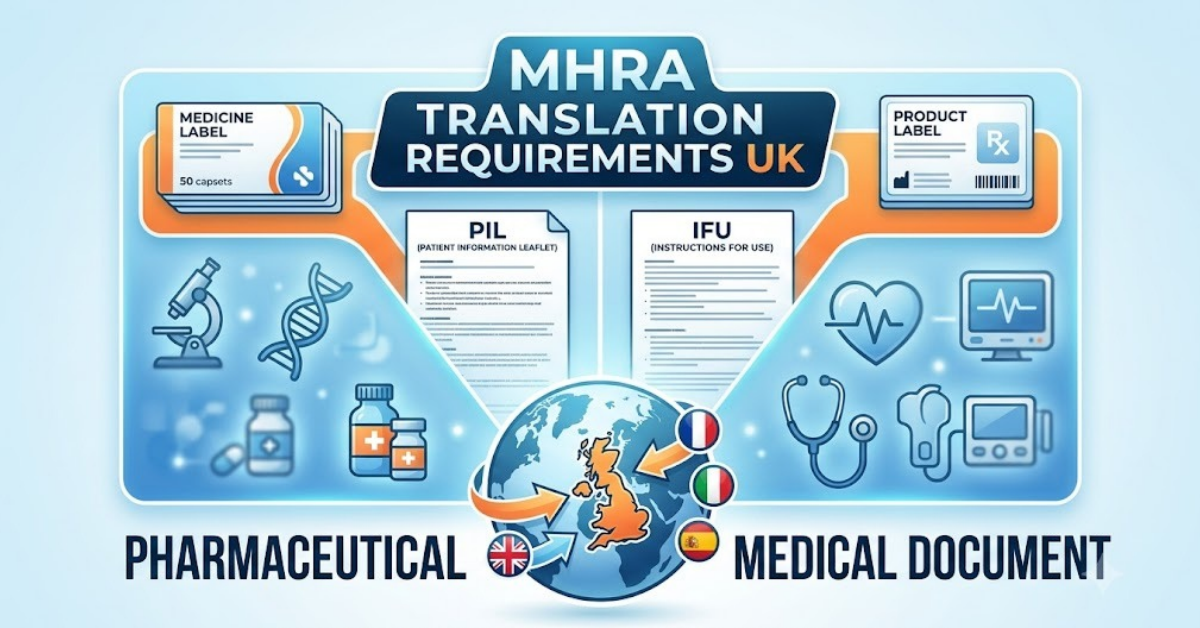
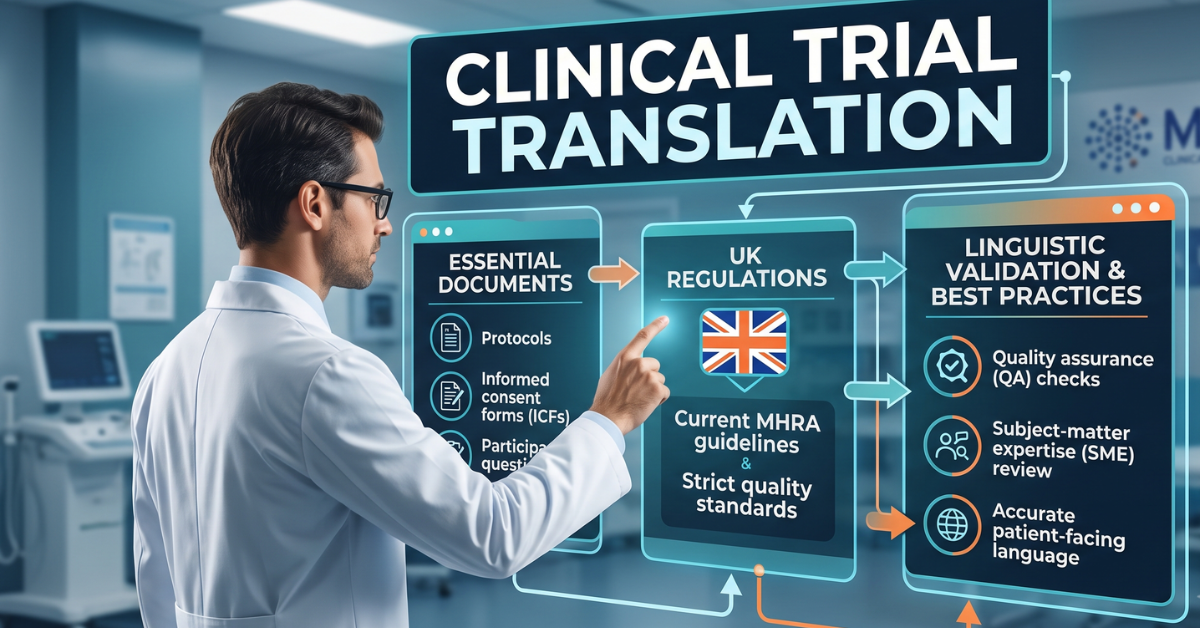
Medical and pharmaceutical document translation requires far more than converting words from one language into another. Healthcare content often contains specialist terminology, clinical information, pharmaceutical names, dosage instructions, technical details, and patient-facing information where accuracy and consistency are essential.
For organizations operating in or entering the UK market, translation may also require careful localization for British English, the intended audience, document purpose, and relevant industry requirements.
Whether you need to translate clinical research documents, pharmaceutical documentation, medical reports, patient information, or other healthcare content, working with professional medical translation services in the UK can help ensure that the translated material communicates the intended meaning clearly and consistently.
Quick Answer: How Do You Translate Medical and Pharmaceutical Documents for the UK Market?
To translate medical and pharmaceutical documents for the UK market, first identify the document type, purpose, target audience, language pair, and specialist terminology involved. The content should then be translated by appropriately qualified language professionals, localized for British English where required, reviewed for terminology and consistency, and subjected to suitable quality checks before delivery.
The exact translation workflow depends on the nature and intended use of the document. Patient-facing information, clinical research materials, pharmaceutical documentation, and technical medical content may each require different levels of linguistic and subject-matter review.
What Is Medical and Pharmaceutical Translation for the UK Market?
Medical and pharmaceutical translation involves translating specialist healthcare, clinical, scientific, and pharmaceutical content from a source language into another language while preserving its meaning, terminology, context, and intended purpose.
For UK audiences, localization may also involve adapting spelling, terminology, phrasing, and communication conventions to suit British English.
Medical translation may cover content intended for patients, healthcare professionals, researchers, medical organizations, or other audiences. Pharmaceutical translation can involve documents associated with medicines, pharmaceutical research, product information, clinical development, and technical pharmaceutical activities.
Because the consequences of inaccurate information can be significant, these translations require careful attention to terminology, context, consistency, and quality assurance.
How to Translate Medical Documents for the UK Market
A structured translation process can help maintain the accuracy and consistency of medical and pharmaceutical content.
1. Understand the Document Type and Purpose
Before translation begins, identify what the document is and how it will be used.
For example, a medical report intended for a healthcare professional may require a different terminology and writing style from patient-facing information. Similarly, clinical research documentation may have different requirements from general healthcare website content.
Understanding the purpose of the document helps the translation team make appropriate linguistic and terminology decisions.
2. Identify the Target Audience
Medical content may be read by very different audiences, including:
Healthcare professionals
Patients and caregivers
Researchers
Pharmaceutical professionals
Clinical research teams
Medical device organizations
Regulatory and compliance teams
The language should be appropriate for the intended audience while preserving the technical accuracy of the source material.
Patient-facing content, for example, may need to communicate complex information clearly without unnecessarily complicated language.
3. Review Medical and Pharmaceutical Terminology
Specialist terminology is one of the most important considerations in medical and pharmaceutical translation.
Documents may contain:
Medical conditions and diagnoses
Clinical terminology
Drug and pharmaceutical terminology
Dosage information
Abbreviations
Treatment terminology
Laboratory terminology
Technical descriptions
Clinical research terminology
Medical device terminology
Terminology should be translated consistently throughout the document. When several documents are part of the same project, maintaining a consistent terminology approach across the wider document set becomes particularly important.
4. Adapt the Content for British English
A translation intended for UK readers should take appropriate British English conventions into account.
Localization may involve differences in:
Spelling
Medical terminology
Vocabulary
Phrasing
Units and formatting
Communication style
For example, British and American English may use different spellings or terms for certain words. Simply translating the source content without considering the UK audience may therefore result in language that is technically understandable but not appropriately localized.
5. Review the Translation for Accuracy and Consistency
Medical and pharmaceutical documents should undergo suitable quality checks after translation.
Depending on the document and project requirements, checks may include:
Terminology consistency
Grammar and language accuracy
Numbers and measurements
Names and abbreviations
Formatting
Missing or duplicated content
Consistency with previously translated materials
Appropriate British English usage
The depth of review should reflect the complexity and intended use of the document.
How Is Pharmaceutical Translation Different from General Translation?
General translation focuses primarily on accurately communicating meaning between languages. Pharmaceutical translation requires additional familiarity with specialized terminology and technical subject matter.
Pharmaceutical documents can contain information relating to medicines, pharmaceutical products, clinical research, technical processes, product information, and patient communication.
This means pharmaceutical translation requires careful attention to terminology, context, consistency, numbers, measurements, names, and instructions.
The same principle applies to medical document translation in the UK: the translator needs to understand not only the source and target languages but also the subject matter and intended audience.
Medical Translation vs Pharmaceutical Translation
There can be overlap between the two fields, particularly where pharmaceutical products, clinical research, healthcare professionals, and patient information are involved.
What Medical and Pharmaceutical Documents Require Translation?
Medical and pharmaceutical translation may be required for a wide range of documents.
Clinical Research Documents
Organizations involved in clinical research may require translation of research-related materials, study documents, questionnaires, participant information, and other content depending on the project.
Patient Information Materials
Patient-facing documents need to communicate healthcare information clearly and accurately. Translation should preserve the intended meaning while making the language appropriate for the target audience.
Medical Reports
Medical reports can contain highly specialized terminology and sensitive healthcare information. Accurate translation is important for preserving the meaning of the original document.
Pharmaceutical Documentation
Pharmaceutical companies may require translation for product-related, technical, research, and patient-facing materials.
Medical Device Documentation
Medical device organizations may require translation of technical documentation, instructions, training materials, product information, and other relevant content.
Scientific and Technical Documents
Research papers, scientific materials, technical documents, and other specialist content may also require translation by professionals familiar with the relevant terminology.
Why Is British English Important in UK Medical Translation?
British English is an important consideration when translated healthcare content is intended specifically for UK audiences.
Using appropriate UK spelling, terminology, phrasing, and communication conventions can make translated content feel natural and relevant to its intended readers.
However, localization should not change the underlying meaning of medical or pharmaceutical information. The objective is to make the content appropriate for the UK audience while preserving the accuracy of the source material.
What Quality Checks Should Medical Translations Include?
Quality assurance is an important part of professional medical and pharmaceutical translation.
Depending on the project, quality checks may consider:
1. Terminology:
Are specialist medical and pharmaceutical terms used consistently?
2. Accuracy:
Does the translated content accurately communicate the source information?
3. Numbers and measurements:
Are figures, units, dates, and other numerical information correctly handled?
4. Consistency:
Are recurring terms, product names, abbreviations, and phrases used consistently?
5. Language:
Is the translated content grammatically correct and appropriate for the target audience?
6. Formatting:
Has the structure and formatting of the original document been appropriately maintained?
7. Localization:
Does the content follow suitable British English conventions for the intended UK audience?
A professional translation workflow can combine linguistic review, specialist expertise, technology, and quality-control procedures according to the requirements of the project.
Can Machine Translation Be Used for Medical Documents?
Technology can support parts of a translation workflow, including terminology management and translation assistance. However, medical and pharmaceutical content requires appropriate human oversight.
The suitability of machine translation or other technology-assisted approaches depends on factors such as the document type, complexity, confidentiality, intended use, language pair, and required level of review.
For specialist healthcare content, professional human review can help identify terminology, contextual, linguistic, or consistency issues that automated systems may not recognize correctly.
How to Choose a Medical Translation Service in the UK
When selecting a medical or pharmaceutical translation provider, consider more than price and turnaround time.
Important factors include:
1. Relevant subject-matter experience
Look for experience with medical, pharmaceutical, healthcare, clinical, or related content.
2. Qualified language professionals
The translators should have appropriate linguistic expertise and familiarity with specialist terminology.
3. Terminology management
Consistent terminology is particularly important when translating multiple related documents.
4. Quality assurance
Ask about the provider's review and quality-control processes.
5. British English localization
Make sure the provider understands the language conventions relevant to UK audiences.
6. Experience with your document type
A provider experienced with your specific type of content may be better positioned to understand its terminology and purpose.
7. Confidentiality and secure handling
Medical and pharmaceutical documents may contain sensitive information, so document handling and confidentiality processes should be considered.
8. Scalability
Organizations with multilingual or ongoing requirements may benefit from a provider capable of managing larger document sets while maintaining consistency.
Why Choose MyTranscriptionPlace?
At MyTranscriptionPlace, we combine language expertise, specialist workflows, technology, and quality checks to support accurate and consistent translation across specialist content.
Our experience spans healthcare, pharmaceutical, research, legal, academic, and media projects. This enables us to approach specialist documents with careful attention to terminology, context, language, and intended audience.
Whether you need medical document translation for the UK, pharmaceutical documentation translation, clinical research materials, or other specialist content, our goal is to provide a reliable translation process tailored to the requirements of your project.
Key Takeaways
Medical and pharmaceutical translation requires more than literal language conversion.
The document's purpose and intended audience should be considered before translation begins.
Specialist medical and pharmaceutical terminology needs to be accurate and consistent.
UK-focused content may require appropriate British English localization.
Medical reports, clinical research materials, patient information, pharmaceutical documentation, medical device content, and scientific materials may require specialist translation.
Quality checks can help identify terminology, language, numerical, formatting, and consistency issues.
The appropriate translation workflow depends on the document type, language pair, intended use, and project requirements.
Professional translation support can help organizations communicate specialist healthcare and pharmaceutical information clearly across languages.
Our Best Translation Services
English to Indonesian Translation | English to Spanish Translation | English to Italian Translation | English to Russian Translation | English to Danish Translation | English to Vietnamese Translation | English to Japanese Translation | English to Finnish Translation | English to Dutch Translation | English to Arabic Translation | English to Norwegian Translation | English to Greek Translation.
Need Medical or Pharmaceutical Documents Translated for the UK?
Accurate medical and pharmaceutical translation requires careful attention to terminology, context, consistency, language conventions, and the intended audience.
MyTranscriptionPlace provides professional translation support for medical, pharmaceutical, healthcare, research, and other specialist content.
Need help translating your documents for the UK market? Contact MyTranscriptionPlace to discuss your requirements and request a translation quote.
Request a Translation Quote
FAQs About Medical & Pharmaceutical Translation in the UK
1. What is medical translation in the UK?
Medical translation in the UK is the translation and localization of healthcare-related content for a UK audience. It can include medical reports, patient information, clinical research materials, healthcare content, and other documents requiring accurate medical terminology and appropriate language conventions.2. What is pharmaceutical translation?
Pharmaceutical translation involves translating documents related to pharmaceutical products, drug development, clinical research, and other pharmaceutical content. It requires careful handling of specialist terminology, technical information, consistency, and context.3. How do you translate medical documents for the UK market?
Medical documents should be translated by first identifying the document type, intended audience, purpose, and terminology involved. The content can then be translated and localized for British English where appropriate, followed by suitable linguistic, terminology, formatting, and quality checks.4. Why is British English important for UK medical translation?
British English helps ensure that translated content is appropriate for UK readers. Depending on the document, localization may involve spelling, terminology, phrasing, and other language conventions while preserving the original meaning.5. What documents can medical translation services translate?
Medical translation services may cover medical reports, patient information, clinical research materials, healthcare content, questionnaires, medical device documentation, scientific materials, and other healthcare-related documents.6. What pharmaceutical documents require translation?
Pharmaceutical translation may be required for clinical research documents, product-related information, technical documentation, patient-facing materials, scientific content, and other pharmaceutical documents.7. What is the difference between medical and pharmaceutical translation?
Medical translation generally covers healthcare and medical content, while pharmaceutical translation focuses more specifically on medicines, pharmaceutical products, drug-related information, clinical development, and technical pharmaceutical documentation. Both require specialist terminology and appropriate quality control.8. Can machine translation be used for medical documents?
Technology can assist certain parts of the translation workflow, but the suitability of machine translation depends on the document and its intended use. Medical and pharmaceutical content may require appropriate human review to help identify terminology, contextual, linguistic, and consistency issues.9. How long does medical document translation take?
Turnaround time depends on factors such as document length, language pair, technical complexity, formatting requirements, and review requirements. A translation provider can provide a more accurate timeframe after assessing the documents and project requirements.10. How can I choose a medical translation service in the UK?
Look for a provider with relevant medical or pharmaceutical experience, qualified language professionals, terminology-management capabilities, quality-assurance processes, confidentiality procedures, and experience with the type of documents you need translated.
Nishi Singh
(Content Writer & SEO Manager)
She is an SEO Manager with over 8 years of experience in marketing and content creation. She specializes in SEO, content strategy, and paid advertisements, helping website owners across SaaS, B2B businesses, and e-commerce platforms achieve measurable growth. With a strong focus on driving organic traffic and crafting impactful content, Nishi has established herself as a trusted expert in the digital marketing space. When she's not optimizing websites, she channels her energy into marathon running, embracing challenges both on and off the track.