The UK is home to a major pharmaceutical, biotechnology, healthcare, clinical research and medical device industry, making accurate multilingual communication essential for organisations operating across international markets. Life sciences translation services UK providers help organisations translate highly specialised scientific, medical, technical and regulatory content while preserving terminology, meaning, accuracy and consistency.
Unlike general translation, life sciences translation requires linguists with relevant subject-matter expertise and an understanding of the terminology and requirements associated with pharmaceuticals, clinical research, healthcare and medical devices.
From pharmaceutical documents and clinical trial materials to medical device Instructions for Use (IFUs), technical documentation and patient-facing information, specialist translation helps organisations communicate critical information clearly across languages.
Life Sciences Translation UK: At a Glance
What Is Life Sciences Translation in the UK?
Life sciences translation is the specialist translation of scientific, medical, pharmaceutical, healthcare, biotechnology, clinical research and medical device content from one language into another.
The objective is not simply to translate individual words. Specialist life sciences translation must preserve the meaning, terminology, technical detail and intended purpose of the original content while making it appropriate for the target language and audience.
Life sciences organisations may require translation for:
Pharmaceutical and drug development documents
Clinical trial and clinical research materials
Medical device documentation
Healthcare and patient information
Scientific and biotechnology content
Regulatory and compliance documentation
Technical manuals and instructions
Marketing and educational materials
Because life sciences content can contain safety-critical or highly technical information, organisations should work with translation providers that understand the relevant scientific and medical terminology.
What Types of Life Sciences Content Need Translation?
The type of content requiring translation depends on the organisation, product, research programme and target market.
Pharmaceutical Translation Services UK
Pharmaceutical translation services UK cover the translation of documents used throughout the pharmaceutical development, clinical research, regulatory and commercial lifecycle.
Pharmaceutical content often contains specialised terminology relating to medicines, active ingredients, dosage, clinical studies, safety, pharmacology and regulatory requirements. Translation therefore requires more than general language proficiency.
A specialist pharmaceutical translation workflow can help organisations maintain terminology and consistency across large volumes of documentation and multiple languages.
What Pharmaceutical Documents Require Translation?
Depending on the project and target market, pharmaceutical translation may include:
Clinical trial protocols
Clinical study reports
Investigator brochures
Patient information leaflets
Drug and product labels
Safety reports
Pharmacovigilance documentation
Regulatory submissions
Product information
Packaging content
Patient-facing materials
Scientific and research documentation
Why Is Pharmaceutical Translation Important?
Pharmaceutical translation helps companies communicate drug-related, safety, clinical and regulatory information to different audiences and markets.
Accurate translation can be particularly important when content is intended for patients, healthcare professionals, researchers, business partners or regulatory stakeholders. Consistent terminology also helps organisations maintain clarity across related documents and different stages of a product's lifecycle.
Clinical Trial Translation in the UK
Clinical trial translation is the specialist translation of documents used to conduct and support clinical research across different languages.
International clinical studies may involve participants, researchers, investigators, healthcare professionals and other stakeholders who speak different languages. Translating study materials accurately helps ensure that important information can be communicated consistently to the relevant audiences.
Clinical trial translation can involve participant-facing materials as well as documentation used by research teams and other stakeholders.
Which Clinical Trial Documents Need Translation?
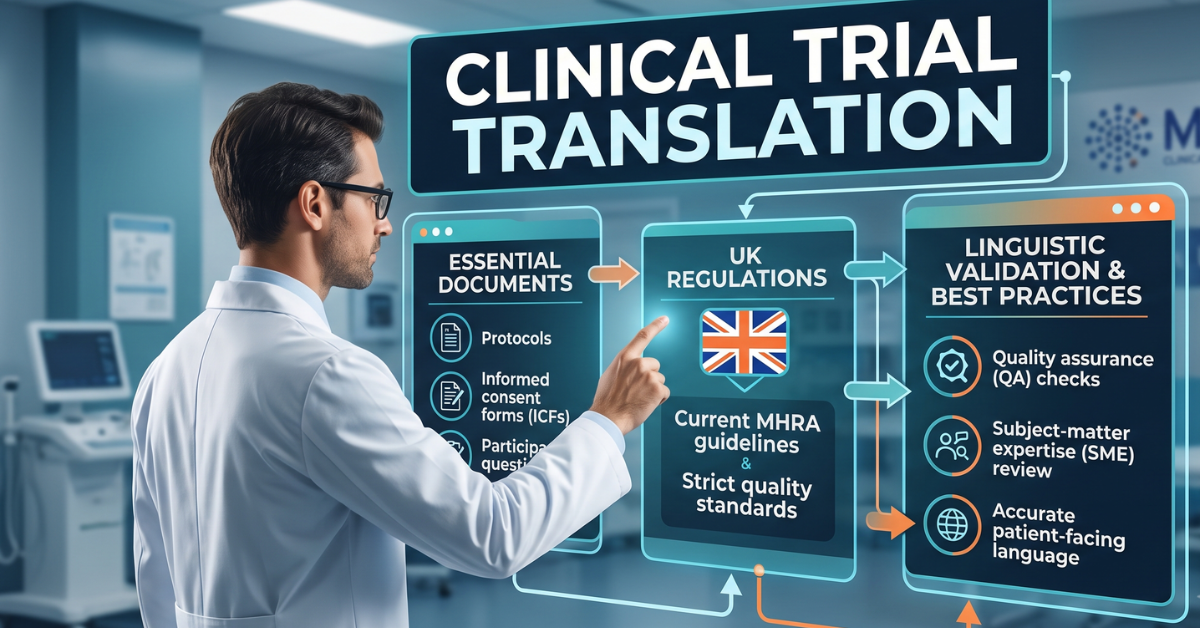
Common clinical trial translation requirements may include:
Informed consent forms
Participant information sheets
Recruitment materials
Clinical trial protocols
Patient questionnaires
Patient diaries
Case report forms
Research documentation
Ethics-related documentation
Safety information
Participant communications
Study-related materials
The exact documents requiring translation depend on the study, target country, intended audience and applicable requirements.
Why Is Accurate Clinical Trial Translation Important?
Clinical research involves information that participants and research teams need to understand correctly. Accurate translation can help:
Communicate study procedures clearly
Present participant information consistently
Help participants understand relevant study information
Maintain consistency between multilingual study materials
Support communication across international research sites
Reduce ambiguity in specialised terminology
For participant-facing materials, translation may also need to account for language, cultural context and the way information is understood by the target audience.
Translation, Localisation and Linguistic Validation
Translation, localisation and linguistic validation are related but distinct processes.
Translation converts content from one language into another while preserving the intended meaning.
Localisation adapts content to the linguistic and cultural context of the target audience.
Linguistic validation may be used for certain clinical research and patient-reported outcome materials to help confirm that a translated version conveys the intended concepts of the original.
The appropriate process depends on the document type, study requirements and target population.
Medical Device Translation UK
Medical device translation involves translating documentation, labelling, software content and user information required to explain how a medical device should be used safely and correctly in different markets.
Medical device content can combine medical, scientific, engineering and technical terminology. Even small inconsistencies in terminology can affect how users interpret instructions, warnings or product information.
For this reason, medical device manufacturers can benefit from specialist translation workflows designed around technical accuracy and terminology consistency.
What Medical Device Documents Require Translation?
Medical device translation may include:
Instructions for Use (IFUs)
User manuals
Technical documentation
Product labels
Packaging information
Safety warnings
Installation instructions
Maintenance instructions
Training materials
Patient-facing information
Software and user-interface content
Product specifications
Why Is Medical Device Translation Important?
Accurate medical device translation helps manufacturers communicate essential product and safety information to users in different languages.
Depending on the product and target market, translated content may be used by:
Patients
Doctors
Nurses
Technicians
Healthcare organisations
Distributors
Other medical device users
The translation process should preserve technical terminology, instructions, warnings and other critical information while adapting the content appropriately for the intended market and audience.
UK Regulatory Considerations for Life Sciences Translation
Life sciences organisations operating in the UK may need to consider regulatory, safety, privacy and market-specific requirements when preparing multilingual content.
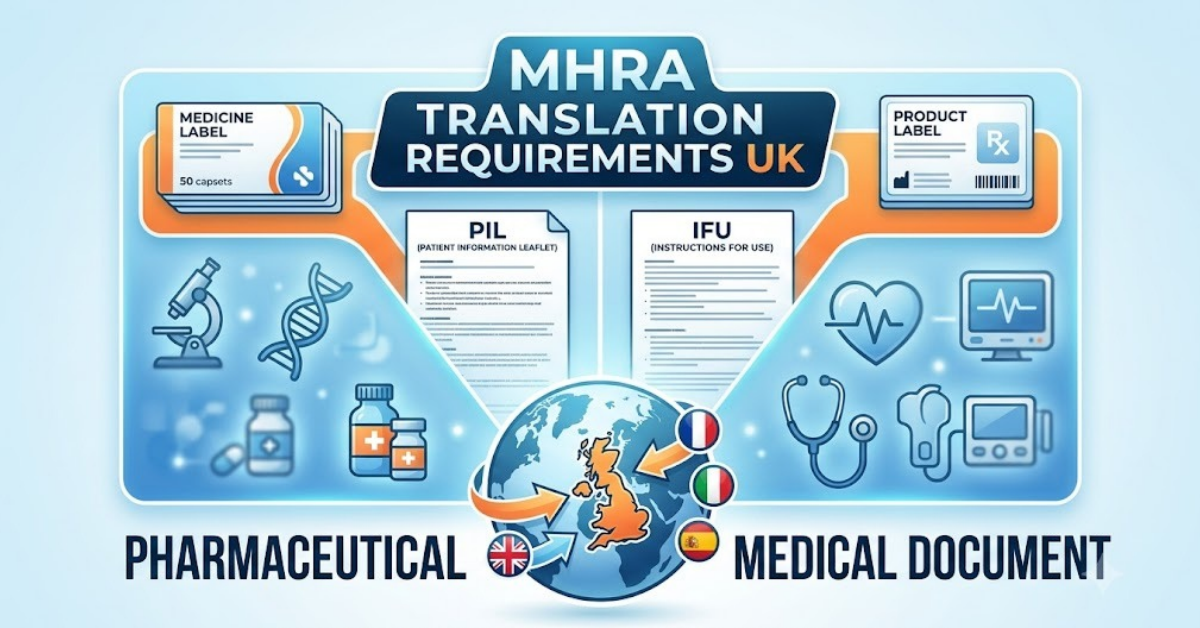
For example, pharmaceutical, clinical research and medical device organisations may encounter requirements associated with the Medicines and Healthcare products Regulatory Agency (MHRA) and other relevant authorities or processes, depending on the nature of their product or research activity.
Translation requirements are not identical for every document or organisation. They can vary according to:
Product type
Document type
Intended market
Target audience
Clinical research requirements
Regulatory pathway
Patient-facing requirements
Applicable data protection obligations
Organisations should establish the specific translation and localisation requirements applicable to their project rather than assuming that every life sciences document follows the same process.
Data Privacy and Confidentiality
Life sciences translation projects can involve confidential research, patient, pharmaceutical, clinical and technical information.
Translation providers should therefore have appropriate processes for protecting sensitive information and managing confidential documents. Where applicable, organisations should also consider relevant data protection and privacy obligations, including UK GDPR requirements.
Any additional privacy or security framework, such as HIPAA, should only be referenced where it is genuinely relevant to the information, project or target market.
How Does Life Sciences Translation Work?
A specialist life sciences translation project typically involves several stages designed to maintain linguistic, technical and terminology consistency.
1. Content Assessment
The translation team reviews the documents, source language, target languages, subject matter, intended audience and project requirements.
2. Terminology Preparation
Important scientific, pharmaceutical, medical and technical terms are identified to help establish consistent terminology throughout the project.
3. Specialist Translation
Qualified linguists translate the content while considering the relevant scientific, medical or technical context.
4. Review and Quality Assurance
The translated content is reviewed for language quality, terminology, consistency, accuracy and adherence to project requirements.
5. Localisation and Formatting
Where required, content is adapted for the target market and formatted appropriately for documents, software, packaging or other applications.
6. Final Quality Check
The completed files undergo a final review before delivery to identify issues relating to terminology, language, formatting and consistency.
Pharmaceutical vs Clinical Trial vs Medical Device Translation
Although these areas are closely connected, their translation requirements can differ significantly.
Understanding these differences helps organisations select a translation workflow appropriate to their specific life sciences requirements.
How to Choose a Life Sciences Translation Company in the UK
Choosing the right life sciences translation company UK organisations can rely on involves looking beyond general translation capability.
Consider the following factors:
Life Sciences Expertise
Look for experience in the relevant area, such as pharmaceuticals, clinical research, biotechnology, healthcare or medical devices.
Subject-Matter Linguists
Specialist content should be handled by linguists with appropriate knowledge of scientific, medical or technical terminology.
Terminology Management
A structured terminology process can help maintain consistency across documents, languages and multiple projects.
Quality Assurance
Ask about proofreading, peer review, quality checks and other processes used to verify translated content.
Confidentiality and Data Security
Sensitive pharmaceutical, clinical and medical information should be handled using appropriate security and confidentiality procedures.
Multilingual Project Management
For international projects, a provider should be capable of coordinating multiple languages while maintaining consistency between deliverables.
Scalability
Large pharmaceutical, clinical research and medical device projects may involve significant document volumes and tight timelines, making project management and scalable workflows important considerations.
Why Choose MyTranscriptionPlace for Life Sciences Translation?
At MyTranscriptionPlace, we provide specialist language services designed to support pharmaceutical, healthcare, clinical research and life sciences organisations.
Our approach combines language expertise, subject-matter knowledge and quality-control processes to help clients manage complex multilingual content.
Specialist Linguistic Expertise
Our language teams support specialised scientific, medical and technical content while focusing on terminology and contextual accuracy.
Quality and Consistency
Peer review and quality-checking processes help maintain consistency across documents and projects.
Confidentiality
Life sciences organisations often work with sensitive research, patient, pharmaceutical and technical information. We prioritise confidentiality and appropriate handling of client information throughout the translation workflow.
Pharmaceutical and Clinical Research Support
Our services can support pharmaceutical translation, clinical research translation and multilingual medical content across a range of document types.
Medical Device Translation
We support the translation of medical device documentation, including technical and user-facing content where specialist terminology and clarity are essential.
For organisations requiring multilingual life sciences content, MyTranscriptionPlace can provide translation support tailored to the subject matter, languages, document types and project requirements.
The Future of Life Sciences Translation
The life sciences industry is becoming increasingly international, with pharmaceutical research, biotechnology, clinical trials and medical device development frequently involving multiple countries and languages.
As these activities become more global, organisations need reliable ways to communicate complex scientific and medical information across languages while maintaining accuracy and consistency.
Technology can support translation workflows through terminology management, translation-memory systems, quality checks and other tools. However, specialist human linguistic and subject-matter expertise remains important for complex scientific, medical and regulatory content.
The future of life sciences translation services UK will therefore increasingly combine specialised human expertise with technology-enabled workflows to support accurate, consistent and scalable multilingual communication.
Our Best Translation Services
English to Indonesian Translation | English to Spanish Translation | English to Italian Translation | English to Russian Translation | English to Danish Translation | English to Vietnamese Translation | English to Japanese Translation | English to Finnish Translation | English to Dutch Translation | English to Arabic Translation | English to Norwegian Translation | English to Greek Translation.
Frequently Asked Questions About Life Sciences Translation UK
1. What are life sciences translation services in the UK?
Life sciences translation services are specialist language services for pharmaceutical, biotechnology, healthcare, clinical research and medical device content. They can cover scientific, technical, regulatory and patient-facing documents and require careful handling of specialised terminology, meaning, accuracy and consistency.2. What is included in life sciences translation?
Life sciences translation can include pharmaceutical documents, clinical trial materials, medical device documentation, healthcare information, scientific research content, regulatory documents, patient information, technical manuals and other specialised materials.3. Which industries use life sciences translation services?
Common users include pharmaceutical companies, biotechnology organisations, clinical research organisations, medical device manufacturers, healthcare organisations, scientific research organisations and other businesses working with specialised life sciences content.4. What pharmaceutical documents require translation?
Pharmaceutical documents that may require translation include clinical trial protocols, clinical study reports, investigator brochures, patient information leaflets, product information, labels, safety reports, pharmacovigilance documentation, regulatory submissions and packaging content.5. What is clinical trial translation?
Clinical trial translation is the translation of documents and materials used during clinical research into the languages required for participants, researchers, investigators, healthcare professionals or other stakeholders. It can include informed consent forms, participant information, protocols, questionnaires and recruitment materials.6. Which clinical trial documents need translation?
Depending on the study and target market, clinical trial translation may include informed consent forms, participant information sheets, recruitment materials, clinical protocols, questionnaires, patient diaries, case report forms, safety information and other study-related documentation.7. What is linguistic validation in clinical research?
Linguistic validation is a process that may be used for certain clinical research and patient-facing instruments to help confirm that a translated version accurately reflects the concepts and intended meaning of the original. The process required depends on the specific instrument, study and applicable requirements.8. What medical device documents require translation?
Medical device translation may include Instructions for Use (IFUs), user manuals, technical documentation, product labels, packaging information, safety warnings, maintenance instructions, training materials, patient information and software or user-interface content.9. Why is medical device translation important?
Medical device translation helps communicate instructions, warnings, safety information and technical details clearly to users in different languages. Accurate terminology and appropriate localisation can help users understand how a device should be used and maintained.10. What is the difference between medical and pharmaceutical translation?
Medical translation is a broad category covering healthcare and medical content, while pharmaceutical translation focuses more specifically on medicines, drug development, pharmaceutical research, safety information and related documentation. Both require specialist terminology and subject-matter expertise.11. How do I choose a life sciences translation company in the UK?
Consider the provider's experience in your specific life sciences sector, subject-matter expertise, terminology management, quality-assurance procedures, confidentiality practices, multilingual capabilities and ability to manage the volume and complexity of your project.12. How is confidential information handled during life sciences translation?
Life sciences translation can involve sensitive pharmaceutical, clinical, patient and technical information. Translation providers should have appropriate confidentiality, security and data-handling processes and should address applicable privacy obligations based on the project and information involved.
Nishi Singh
(Content Writer & SEO Manager)
She is an SEO Manager with over 8 years of experience in marketing and content creation. She specializes in SEO, content strategy, and paid advertisements, helping website owners across SaaS, B2B businesses, and e-commerce platforms achieve measurable growth. With a strong focus on driving organic traffic and crafting impactful content, Nishi has established herself as a trusted expert in the digital marketing space. When she's not optimizing websites, she channels her energy into marathon running, embracing challenges both on and off the track.