AI transcription is transforming healthcare documentation by converting medical conversations, clinician dictations, and recorded consultations into written text. While these tools can help healthcare organizations streamline documentation, they also raise important questions about patient privacy, data security, and regulatory compliance.
Is AI transcription HIPAA and GDPR compliant? Yes, AI transcription can be used in compliant workflows, but compliance depends on the applicable laws, the service provider's practices, contractual arrangements, and how patient information is processed and protected.
In the United States, healthcare organizations subject to HIPAA must evaluate how transcription providers handle protected health information (PHI) and whether a Business Associate Agreement (BAA) is required. Under the General Data Protection Regulation (GDPR), organizations processing personal health data within its scope must meet applicable requirements for lawful processing, data security, and the protection of special-category data.
Before uploading patient recordings to an AI transcription platform, organizations should review its data retention policies, access controls, encryption practices, third-party integrations, international data transfers, and use of information for AI model training.
This guide explains HIPAA and GDPR requirements for AI medical transcription, compares the two frameworks, and provides a practical checklist for choosing a secure healthcare transcription provider.
What Is AI Medical Transcription?
AI medical transcription uses speech recognition technology to convert medical recordings, clinician dictations, and healthcare conversations into written documentation. It can support consultation notes, clinical reports, medical histories, and other healthcare documentation workflows.
These recordings may contain sensitive information, including patient names, diagnoses, treatment details, prescriptions, and medical histories. When the information identifies or can be linked to an individual, it may be subject to applicable privacy and data protection requirements.
AI transcription can reduce manual documentation work, but it also introduces considerations around accuracy, access, storage, and data processing. Speech recognition systems may misinterpret medical terminology, accents, abbreviations, or unclear speech, potentially resulting in errors in clinical records.
Healthcare organizations should understand how a transcription provider collects, processes, stores, transfers, and deletes recordings and transcripts. They should also establish whether the provider shares data with third parties or uses submitted content to train or improve AI models.
For sensitive healthcare documentation, organizations should evaluate both transcription accuracy and data protection before selecting a service.
Is AI Transcription HIPAA Compliant?
AI transcription can be used in a HIPAA-compliant workflow when the organizations, services, and data handling practices involved meet applicable HIPAA requirements.
The Health Insurance Portability and Accountability Act (HIPAA) establishes requirements for protecting certain health information handled by covered entities and their business associates. Protected health information (PHI) includes individually identifiable health information that falls within HIPAA's scope.
A transcription provider that creates, receives, maintains, or transmits PHI on behalf of a covered entity or business associate may qualify as a business associate. The provider's responsibilities depend on the services it performs and the applicable legal requirements.
What Should You Check Before Using AI Transcription Under HIPAA?
Healthcare organizations should evaluate the following areas before sharing PHI with an AI transcription provider:
Business Associate Agreement (BAA): Determine whether the provider qualifies as a business associate and whether a BAA is required. If required, establish the agreement before sharing PHI.
Encryption: Review how electronic PHI is protected during transmission and storage.
Access controls: Confirm that access to patient information is restricted to authorized personnel and monitored appropriately.
Data retention and deletion: Understand how long recordings and transcripts are retained and how deletion requests are handled.
AI model training: Determine whether submitted recordings or transcripts may be used to train or improve AI models.
Third-party services: Identify subcontractors or external AI platforms that may access or process PHI.
Incident response: Review how security incidents are detected, reported, and managed.
Risk management: Assess the provider's security practices as part of the organization's own risk analysis and compliance processes.
A transcription platform's claim that it is “HIPAA compliant” does not automatically establish that every use of the platform meets HIPAA requirements. Healthcare organizations should assess the complete workflow, including their own responsibilities and any applicable contractual obligations.
For official guidance, refer to the U.S. Department of Health and Human Services' guidance on business associates.
Is AI Transcription GDPR Compliant?
AI transcription can comply with GDPR when the processing of personal data meets the applicable requirements of the General Data Protection Regulation.
GDPR applies to personal data processing within its territorial scope. Health information is classified as a special category of personal data, which receives additional protection under the regulation.
Processing health data generally requires both a lawful basis under Article 6 and an applicable condition under Article 9. The appropriate basis and condition depend on the circumstances, the organizations involved, and applicable law.
Key GDPR Requirements for Medical Transcription
1. Lawful processing
Organizations must establish an appropriate lawful basis for processing personal data and satisfy the additional requirements applicable to special-category health data.
2. Data processing agreements
Where a transcription provider acts as a processor, the controller-processor relationship generally requires a compliant data processing agreement under Article 28.
3. Security measures
Organizations and providers must implement appropriate technical and organizational measures to protect personal data against unauthorized access, disclosure, loss, or alteration.
4. Data minimization and retention
Only necessary personal data should be processed, and information should not be retained longer than necessary for the applicable purposes, subject to relevant legal obligations.
5. International data transfers
If recordings or transcripts are transferred outside the European Economic Area, the organizations involved must assess applicable GDPR Chapter V requirements and implement appropriate safeguards where required.
6. AI training and secondary use
Organizations should determine whether patient recordings or transcripts are used to train AI models or for other purposes beyond transcription. Any additional use must be assessed against applicable legal requirements and contractual commitments.
7. Data subject rights and impact assessments
Organizations must support applicable data subject rights and assess whether a data protection impact assessment is required for the proposed processing.
GDPR compliance cannot be established solely by encryption or a general promise of confidentiality. It requires an assessment of the data, processing activities, organizations involved, and applicable legal obligations.
For further information, consult the European Commission's guidance on the lawful processing of personal data.
HIPAA vs. GDPR: Key Differences for Medical Transcription
HIPAA and GDPR both address data protection, but they differ in scope, legal requirements, and the types of information and organizations they regulate.
Which framework applies to your organization?
A US healthcare provider may be subject to HIPAA, while an organization processing personal data within GDPR's territorial scope may have GDPR obligations. Some organizations and workflows may need to consider both frameworks, alongside other applicable laws.
Neither framework should be treated as a universal certification for an AI transcription tool. Compliance depends on the actual service, data processing activities, and responsibilities of the organizations involved.
For additional information, review the HHS HIPAA Security Rule guidance and the European Commission's data protection guidance.
What Security Features Should a Healthcare Transcription Provider Have?
Healthcare organizations should assess a transcription provider's security controls, contractual commitments, and data handling procedures before sharing sensitive patient information.
The following checklist can help organizations evaluate whether a provider is suitable for their documentation requirements.
1. Encryption and Secure Data Transfer
Check how recordings and transcripts are protected during transmission and storage. Ask about the encryption methods used, key management practices, and safeguards against unauthorized access.
2. Role-Based Access Controls
Access to patient information should be limited to authorized personnel based on their responsibilities. Ask whether the provider uses appropriate authentication, access monitoring, and audit logging.
3. Data Retention and Deletion Policies
Understand how long audio files and transcripts are retained, whether deletion can be requested, and whether copies remain in backups or third-party systems.
4. AI Model Training Policies
Determine whether submitted recordings or transcripts are used to train or improve AI models. Review whether such use can be restricted and whether the provider's contractual commitments clearly explain how data may be used.
5. Third-Party and Subprocessor Management
Identify the external platforms and subcontractors involved in processing recordings or transcripts. Evaluate their access to patient information and the contractual and security measures governing their activities.
6. Compliance Documentation and Agreements
For applicable US healthcare workflows, determine whether a BAA is required and can be established. For GDPR-covered processing, review the data processing agreement, security commitments, and relevant international transfer arrangements.
7. Incident Response and Breach Management
Ask how the provider identifies and responds to security incidents, communicates with customers, and supports applicable breach notification obligations.
8. Transcription Accuracy and Quality Assurance
Evaluate the provider's ability to handle medical terminology, accents, unclear speech, and specialized vocabulary. Establish a review process for correcting errors before transcripts are used in clinical documentation.
9. Confidentiality and Staff Training
Review confidentiality obligations for personnel who may access recordings or transcripts. Ask about relevant staff training, access restrictions, and procedures for handling sensitive information.
A reliable provider should be able to explain its actual security practices and contractual commitments. Organizations should verify those claims instead of relying exclusively on general statements about security or compliance.
How to Choose a Secure AI Medical Transcription Provider
Choosing an appropriate transcription service involves more than comparing turnaround times and prices. Healthcare organizations must evaluate whether the provider's capabilities, security practices, and contractual terms match their requirements.
Use the following steps when comparing providers.
Step 1: Define your documentation requirements.
Identify the types of recordings, documents, languages, medical terminology, and output formats required for your workflow.
Step 2: Identify applicable privacy obligations.
Determine whether HIPAA, GDPR, or other privacy and data protection laws apply to your organization and the proposed processing activities.
Step 3: Review data processing practices.
Ask where recordings and transcripts are processed, how long they are retained, who can access them, and whether third-party AI systems are involved.
Step 4: Verify contractual commitments.
Review the applicable BAA, data processing agreement, confidentiality provisions, and any restrictions on secondary data use.
Step 5: Assess security and quality assurance.
Examine encryption, access controls, incident response, deletion procedures, and processes for checking transcription accuracy.
Step 6: Confirm suitability before sharing sensitive information.
Obtain the necessary approvals and agreements, validate the workflow, and avoid uploading identifiable patient information until the organization's requirements have been addressed.
A provider should be selected based on verifiable capabilities, appropriate safeguards, and suitability for the intended use—not simply on a claim that it offers compliant AI transcription.
AI Transcription vs. Human Medical Transcription
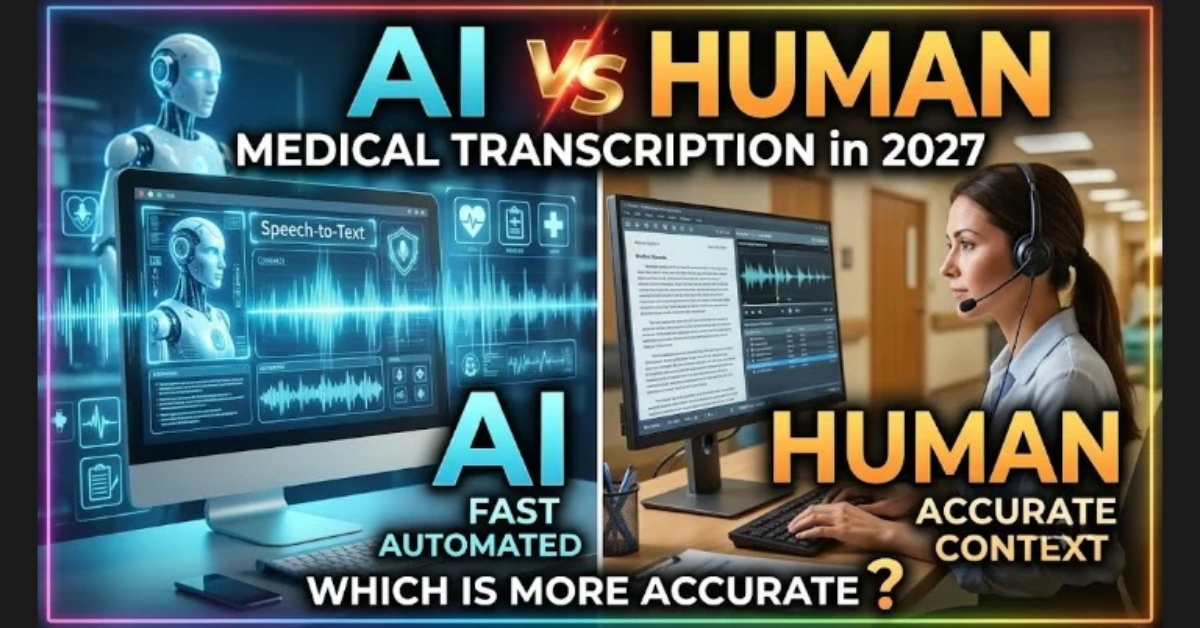
AI and human medical transcription offer different advantages. Neither method is automatically more secure, accurate, or compliant than the other.
1. AI Medical Transcription
AI transcription can process recordings quickly and support high-volume documentation. It may reduce repetitive manual work and help organizations produce written records more efficiently.
However, AI systems may misinterpret accents, medical terminology, abbreviations, or unclear speech. Organizations must also understand how the service processes and retains patient information and whether it uses submitted content for model training.
2. Human Medical Transcription
Human transcriptionists can interpret context, recognize unusual terminology, and help correct errors that automated systems may miss. Their work may be particularly useful for recordings that require specialized knowledge or careful interpretation.
However, human transcription also requires appropriate confidentiality obligations, access controls, secure file handling, and relevant contractual safeguards.
3. Hybrid AI and Human Transcription
A hybrid workflow combines automated transcription with human review. This approach can help identify and correct transcription errors, depending on the quality of the initial output and the review process.
For healthcare organizations, the choice should depend on accuracy requirements, recording quality, turnaround time, cost, data protection obligations, and intended use.
The most appropriate solution is the one that meets the organization's documentation needs while satisfying applicable privacy, security, and contractual requirements.
How MyTranscriptionPlace Supports Healthcare Documentation
Healthcare organizations need transcription workflows that support accurate documentation while protecting sensitive information.
When evaluating a medical transcription provider, organizations should consider experience with medical terminology, quality assurance procedures, confidentiality practices, data handling policies, and the ability to meet relevant contractual requirements.
MyTranscriptionPlace helps organizations explore transcription and language service solutions for their documentation needs. Before sharing patient recordings or other sensitive health information, contact the team to discuss your requirements, the proposed workflow, applicable security measures, data retention practices, and relevant compliance documentation.
If you are looking for a medical transcription solution, contact MyTranscriptionPlace to discuss your documentation requirements and determine whether its services are suitable for your organization's privacy and security needs.
Conclusion
AI transcription can help healthcare organizations streamline documentation, but processing patient recordings requires careful attention to privacy, security, accuracy, and applicable regulatory obligations.
HIPAA compliance depends on the relevant healthcare relationships, protected health information safeguards, contractual arrangements, and other applicable requirements. GDPR compliance requires appropriate lawful processing, additional protections for health data, and suitable technical, organizational, and contractual measures.
Before choosing a transcription provider, healthcare organizations should verify its security practices, retention and deletion policies, AI model training rules, subcontractor arrangements, and compliance documentation.
Whether using AI transcription, human transcription, or a hybrid approach, organizations should select a solution that supports their documentation needs while protecting sensitive information.
MyTranscriptionPlace can help organizations explore suitable transcription and language service options based on their requirements. Discuss your intended workflow and confirm the relevant safeguards before sharing sensitive healthcare data.
Our Best Translation Services
English to Indonesian Translation | English to Spanish Translation | English to Italian Translation | English to Russian Translation | English to Danish Translation | English to Vietnamese Translation | English to Japanese Translation | English to Finnish Translation | English to Dutch Translation | English to Arabic Translation | English to Norwegian Translation | English to Greek Translation.
Frequently Asked Questions
1. Is AI transcription HIPAA compliant?
AI transcription can be used in a HIPAA-compliant workflow when the service and its use meet applicable HIPAA requirements. Check security safeguards, permitted data use, vendor responsibilities, and whether a Business Associate Agreement (BAA) is required.
2. Is AI medical transcription GDPR compliant?
AI medical transcription can comply with GDPR when processing meets applicable requirements, including a lawful basis, an appropriate condition for processing health data, relevant security safeguards, and contractual obligations.
3. Does HIPAA require a BAA for transcription services?
A BAA is generally required when a transcription provider qualifies as a business associate handling protected health information on behalf of a covered entity or another business associate. Applicability depends on the relationship and services involved.
4. Does GDPR protect medical transcription data?
Yes. GDPR treats health information as a special category of personal data. Processing generally requires both an Article 6 lawful basis and an applicable Article 9 condition, alongside other relevant protections.
5. How can I choose a secure medical transcription provider?
Review encryption, access controls, data retention, deletion procedures, subcontractors, incident response, AI model training policies, and contractual commitments. Verify the provider's actual practices before sharing patient information.
6. What is the difference between HIPAA and GDPR for transcription?
HIPAA governs certain protected health information within its US healthcare framework. GDPR applies to personal data processing within its territorial scope and provides additional protections for health data as a special category of personal data.
7. Can AI transcription tools use patient recordings to train their models?
Some AI services may use submitted information to improve their models, while others restrict or prohibit such use. Review the provider's privacy policy, contractual commitments, and applicable legal requirements before uploading patient recordings.
8. Is human medical transcription automatically HIPAA or GDPR compliant?
No. Human transcription is not automatically compliant. Providers and healthcare organizations must follow applicable legal requirements, implement appropriate safeguards, and establish required contractual arrangements.
9. Should healthcare organizations use AI or human transcription?
The choice depends on accuracy requirements, recording quality, turnaround time, security, cost, and intended use. A hybrid workflow combining AI transcription with human review may be suitable for some healthcare documentation tasks.
10. Can medical transcription providers process healthcare data internationally?
Potentially, but the organizations involved must assess applicable legal requirements. GDPR international transfers may require appropriate safeguards under Chapter V. Other relevant privacy, security, and contractual obligations must also be considered.

Nishi Singh
(Content Writer & SEO Manager)
She is an SEO Manager with over 8 years of experience in marketing and content creation. She specializes in SEO, content strategy, and paid advertisements, helping website owners across SaaS, B2B businesses, and e-commerce platforms achieve measurable growth. With a strong focus on driving organic traffic and crafting impactful content, Nishi has established herself as a trusted expert in the digital marketing space. When she's not optimizing websites, she channels her energy into marathon running, embracing challenges both on and off the track.