Translating informed consent forms for clinical trials requires medical accuracy, qualified translators, clear and culturally appropriate language, confidentiality safeguards, and thorough quality checks. The translation must preserve essential information about study procedures, potential risks and benefits, participant rights, and voluntary participation. Depending on the study and applicable regulations, the translated form may also require review and approval by an Institutional Review Board (IRB) or ethics committee.
Professional informed consent translation helps clinical research teams communicate essential study information to participants who speak different languages. At MyTranscriptionPlace, we provide medical translation support to help organizations prepare clear, accurate, and reliable clinical research documents for multilingual audiences.
Informed Consent Form Translation Requirements at a Glance
Before using a translated informed consent form, clinical research teams should consider the following requirements:
Medical accuracy: Preserve the meaning of medical terminology, research procedures, risks, benefits, and participant rights.
Qualified translators: Work with translators who have relevant medical and clinical research experience.
Regulatory and ethical compliance: Follow applicable regulations, IRB or ethics committee requirements, and study-specific instructions.
Plain language: Ensure that participants can understand the translated information.
Cultural appropriateness: Use language and expressions that are suitable for the intended audience without changing the original meaning.
Confidentiality and data protection: Protect sensitive participant information and confidential research documents.
Quality assurance: Check the translation for completeness, consistency, terminology, and accuracy.
Independent review: Arrange additional linguistic review or back-translation when required or appropriate for the study.
These requirements help research teams communicate study information clearly while supporting the informed consent process.
1. Accuracy and Completeness in Informed Consent Translation
Accuracy is one of the most important requirements for informed consent form translation. Every translated section must preserve the meaning and intent of the original document, particularly information about clinical trial procedures, foreseeable risks, potential benefits, alternative options where applicable, and participants' rights.
A mistranslation or omission could cause participants to misunderstand what participation involves. For this reason, clinical trial consent form translation requires careful handling of medical terminology, scientific explanations, instructions, and legal or ethical language.
Professional medical translators should ensure that:
All sections of the original informed consent form are translated completely.
Medical and clinical research terminology is used consistently.
Study procedures, risks, and potential benefits are represented accurately.
Statements about voluntary participation, withdrawal, and confidentiality retain their intended meaning.
No important information is added, removed, or altered without authorization.
Accurate medical consent translation helps research teams provide participants with understandable information so they can make informed decisions about participating in a study.
2. Qualified Medical and Clinical Research Translators
Informed consent forms contain specialized medical, scientific, and clinical research terminology. Translating these documents requires more than general language proficiency. Translators must understand the terminology and context well enough to convey the intended meaning accurately in the target language.
Clinical research organizations should select translators with relevant medical translation experience and familiarity with participant-facing research documents. Experience with clinical trial documentation can help translators handle technical concepts while maintaining clear, accessible language.
When selecting an informed consent translation service, consider the following:
Experience translating medical and clinical research documents.
Proficiency in both the source and target languages.
Familiarity with clinical trial terminology and informed consent concepts.
Established terminology management and quality-control procedures.
Ability to follow sponsor, institutional, and formatting requirements.
MyTranscriptionPlace supports medical and clinical research translation needs, helping organizations communicate research information to multilingual audiences. The translation workflow should be agreed upon in advance to ensure that terminology, document formatting, and review expectations are clearly defined.
3. Regulatory, Ethical, and IRB Requirements
Translated informed consent forms must be prepared in accordance with the applicable regulatory and ethical requirements for the clinical study. These requirements may vary according to the country, research setting, study protocol, sponsor, and reviewing institution.
In the United States, relevant requirements may include the U.S. Food and Drug Administration (FDA) regulations governing informed consent and, where applicable, the Department of Health and Human Services (HHS) regulations for the protection of human research participants.
An Institutional Review Board (IRB) or ethics committee may need to review the translated consent document before it is used. Research teams should confirm the specific submission and approval process with the responsible reviewing body.
Important considerations include:
Identifying the applicable regulatory and ethical framework.
Following the study protocol and sponsor-specific translation requirements.
Preserving all essential informed consent information.
Preparing translated documents in the format required for review.
Obtaining any required IRB or ethics committee approval before using the documents.
Professional informed consent form translation services can support the preparation of translated documents, but translation alone does not establish regulatory compliance or constitute formal IRB approval. The research sponsor and study team remain responsible for confirming the applicable requirements.
For additional guidance, consult the FDA's Informed Consent Guidance and the HHS Office for Human Research Protections' Informed Consent FAQs.
4. Plain Language and Cultural Appropriateness
A translated informed consent form must be understandable to the people who will use it. Even an accurate translation may be difficult to understand if it contains unnecessarily complex sentences, unfamiliar expressions, or technical terminology that is not explained appropriately.
Medical consent form translation should preserve the original meaning while making the information clear and accessible to the intended audience. Translators must also consider cultural context, literacy levels, and the ways medical and research concepts are commonly expressed in the target language.
To improve readability and cultural appropriateness, the translation process should:
Use clear, natural language appropriate for the intended audience.
Avoid unnecessary jargon and overly complicated sentence structures.
Maintain consistent terminology throughout the document.
Use culturally appropriate expressions without changing essential study information.
Preserve explanations of study procedures, potential risks, and participant rights.
Follow any required reading-level or document-formatting guidelines.
Cultural adaptation should never change the substance of the informed consent information. Any necessary clarification or substantive revision should be coordinated with the responsible research team and handled through the appropriate review process.
Clear and culturally appropriate translations help research teams communicate more effectively with participants from diverse linguistic backgrounds.
5. Confidentiality and Secure Document Handling
Informed consent forms and related clinical research documents may contain sensitive personal, medical, or study-related information. Maintaining confidentiality throughout the translation process is therefore an important consideration when choosing a medical translation provider.
Research organizations should understand how their translation provider receives, accesses, stores, transfers, and retains confidential documents. Appropriate safeguards should reflect the sensitivity of the information, contractual obligations, and applicable data protection requirements.
Before sharing documents for translation, research teams should consider:
Confidentiality agreements and appropriate contractual protections.
Restricted access to documents and sensitive information.
Secure document-transfer methods.
Suitable data retention and deletion practices.
Compliance with applicable privacy and data protection obligations.
Clear procedures for handling confidential files throughout the project.
MyTranscriptionPlace can discuss document-handling and confidentiality expectations with clients before a translation project begins. Organizations should confirm the specific security measures and data-handling arrangements that apply to their project before submitting sensitive research materials.
6. Independent Review and Translation Quality Assurance
Quality assurance is essential for ensuring that translated informed consent forms are complete, consistent, and faithful to the source document. Errors in terminology, omitted text, inconsistent phrasing, or formatting problems can affect the clarity of participant-facing information.
A structured review process helps identify potential issues before a translated document is submitted for regulatory or ethical review or used in a clinical study.
Depending on the project requirements, quality checks may include:
Completeness checks: Confirming that all source sections, headings, instructions, and relevant content have been translated.
Terminology checks: Verifying the consistent use of medical and clinical research terms.
Linguistic review: Checking grammar, spelling, readability, and natural language usage.
Accuracy review: Comparing the translated content with the source document to identify omissions or changes in meaning.
Independent review: Having another qualified linguist review the translation when appropriate or required.
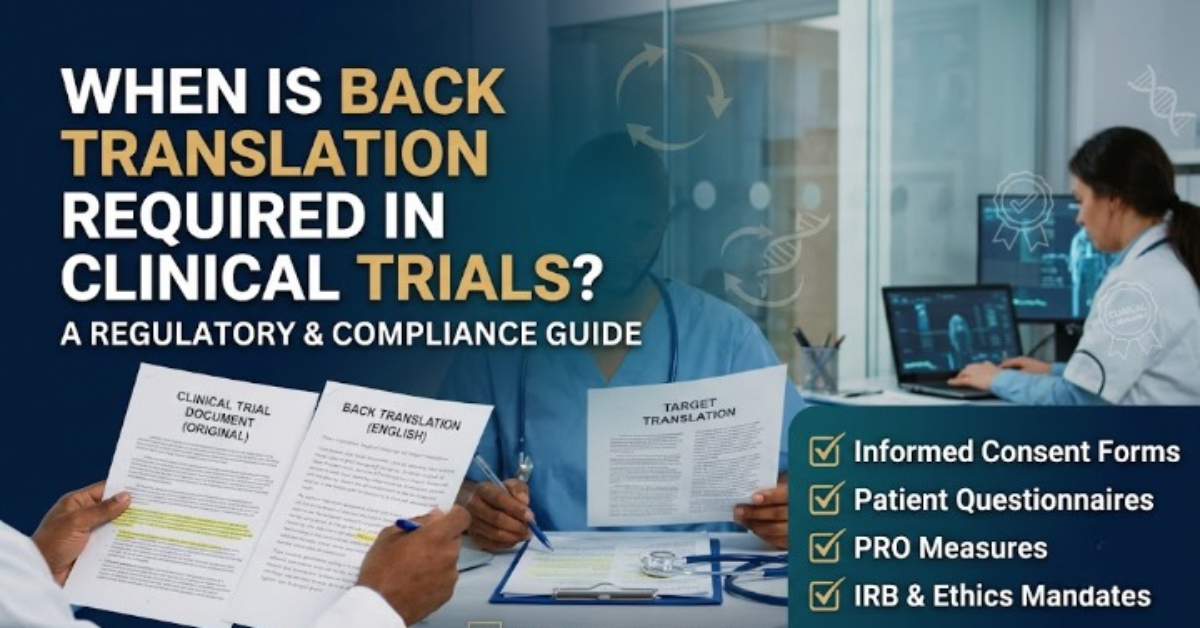
Back-translation: Translating the target-language version back into the source language when specified by the study or quality plan.
Back-translation is one possible quality-control method, but it is not a universal requirement for every informed consent translation. The appropriate review process depends on the sponsor's instructions, institutional requirements, applicable regulations, and the complexity of the document.
Professional medical translation services can help research organizations establish a suitable quality-control workflow and prepare translated documents for the required review process.
Which Clinical Trial Documents Need Translation?
Informed consent forms are only one part of the documentation used in clinical research. Depending on the study, additional participant-facing and research-related materials may need to be translated into the relevant languages.
These documents may include:
Patient information sheets and study information documents.
Clinical trial recruitment materials and participant brochures.
Patient questionnaires and health assessment forms.
Study diaries and participant instructions.
Medication instructions and safety information.
Adverse event reporting forms.
Follow-up communications and participant correspondence.
Other clinical research documents required by the study protocol.
Clinical research translation helps ensure that important study information is communicated consistently across languages. Research teams should identify the required documents, target languages, formatting specifications, and review procedures at the beginning of the project.
What Is the Informed Consent Translation Process?
The process for translating an informed consent form typically involves several steps. The exact workflow depends on the document, language pair, study requirements, and review procedures.
Step 1: Submit the source document
Provide the original informed consent form and identify the target language or languages. Include any available terminology lists, formatting instructions, and sponsor requirements.
Step 2: Assess the project requirements
Confirm the document scope, expected turnaround time, confidentiality arrangements, quality-control expectations, and any applicable IRB or ethics committee requirements.
Step 3: Translate the document
A qualified translator with relevant medical or clinical research experience translates the content while preserving its meaning, terminology, and structure.
Step 4: Complete quality checks
Review the translated document for accuracy, completeness, terminology consistency, grammar, and readability. Arrange any additional independent review or back-translation required by the project.
Step 5: Deliver the translated document
Provide the translation in the agreed format for the research team's review. Confirm that the document meets the specified delivery and formatting requirements.
Step 6: Complete the required review and approval
The responsible research team coordinates submission to the appropriate IRB or ethics committee when required. The translated document should not be used until any required approval has been obtained.
Discussing these steps in advance helps organizations plan translation work around clinical trial timelines and review milestones.
How MyTranscriptionPlace Can Help With Informed Consent Translation
MyTranscriptionPlace provides medical translation support for organizations that need to communicate clinical and research information across languages. Our services can support the translation of informed consent forms and related clinical research documents, with project requirements established according to each client's needs.
When arranging an informed consent translation project, research teams can discuss:
Source and target languages.
Document length, scope, and formatting requirements.
Medical terminology and study-specific instructions.
Confidentiality and document-handling arrangements.
Quality checks and independent review expectations.
Delivery timelines and any applicable review milestones.
Our goal is to help organizations prepare accurate, clear, and consistent translations of medical and clinical research information for multilingual audiences.
If your organization needs informed consent form translation or broader clinical research translation support, contact MyTranscriptionPlace to discuss your documents, target languages, and project requirements.
Get Professional Informed Consent Translation Support
Clear and accurate informed consent translation helps clinical research teams communicate essential study information to participants who speak different languages. From medical terminology and readability to confidentiality and quality assurance, every stage of the translation process should be planned around the study's requirements.
Need your informed consent forms translated? Contact MyTranscriptionPlace to discuss your target languages, document requirements, and clinical research translation needs.
Our Best Translation Services
English to Indonesian Translation | English to Spanish Translation | English to Italian Translation | English to Russian Translation | English to Danish Translation | English to Vietnamese Translation | English to Japanese Translation | English to Finnish Translation | English to Dutch Translation | English to Arabic Translation | English to Norwegian Translation | English to Greek Translation.
Frequently Asked Questions
1. What are the requirements for translating an informed consent form?
An informed consent form must be translated accurately and completely into language understandable to the intended participants. The translation should preserve information about study procedures, potential risks and benefits, participant rights, and voluntary participation. It must also follow applicable regulatory, ethical, and study-specific review requirements.
2. Who should translate clinical trial informed consent forms?
Clinical trial informed consent forms should be translated by qualified linguists with relevant medical or clinical research experience. The translation may also require independent linguistic review, back-translation, or other quality checks, depending on the study requirements.
3. Does an informed consent translation need IRB approval?
When IRB review is required, the translated informed consent document may need to be submitted for review and approval before use. The specific process depends on applicable regulations, the study protocol, and the reviewing IRB's requirements. Research teams should confirm the requirements with the responsible institution.
4. What other clinical trial documents require translation?
Depending on the study, additional documents may include patient information sheets, recruitment materials, clinical trial protocols, patient questionnaires, study diaries, medication instructions, safety information, and participant communications.
5. Is back-translation required for informed consent forms?
Back-translation involves translating a document back into its original language to help identify possible differences in meaning. It may be required or recommended by a sponsor, institution, or quality-control process, but it is not universally mandatory for every informed consent form translation.
6. How long does it take to translate an informed consent form?
Turnaround time depends on document length, technical complexity, the language pair, the number of target languages, formatting needs, and any additional review requirements. Discuss the deadline with your translation provider before scheduling study or submission milestones.
7. How is confidentiality maintained during informed consent translation?
Confidentiality can be supported through appropriate access controls, secure file transfer, confidentiality agreements, and documented data-handling procedures. Research teams should confirm the provider's specific security practices and retention policies before sharing sensitive documents.
8. How can I get an informed consent form translated?
Contact MyTranscriptionPlace with your source document, target language, required format, deadline, and any sponsor or IRB instructions. You should also discuss confidentiality arrangements, quality-control procedures, and any additional review or approval requirements before confirming the project.

Nishi Singh
(Content Writer & SEO Manager)
She is an SEO Manager with over 8 years of experience in marketing and content creation. She specializes in SEO, content strategy, and paid advertisements, helping website owners across SaaS, B2B businesses, and e-commerce platforms achieve measurable growth. With a strong focus on driving organic traffic and crafting impactful content, Nishi has established herself as a trusted expert in the digital marketing space. When she's not optimizing websites, she channels her energy into marathon running, embracing challenges both on and off the track.