AI transcription has transformed the way businesses, researchers, healthcare organizations, legal professionals, academics, and media teams convert speech into text. A recording that once took hours to transcribe can now produce a transcript in minutes.
But speed is different from accuracy.
For a simple recording with clear audio and one speaker, automated transcription can be an efficient way to create a first draft or searchable notes. However, recordings with accents, multiple speakers, background noise, overlapping conversations, specialized terminology, or sensitive information often require more than automated speech recognition.
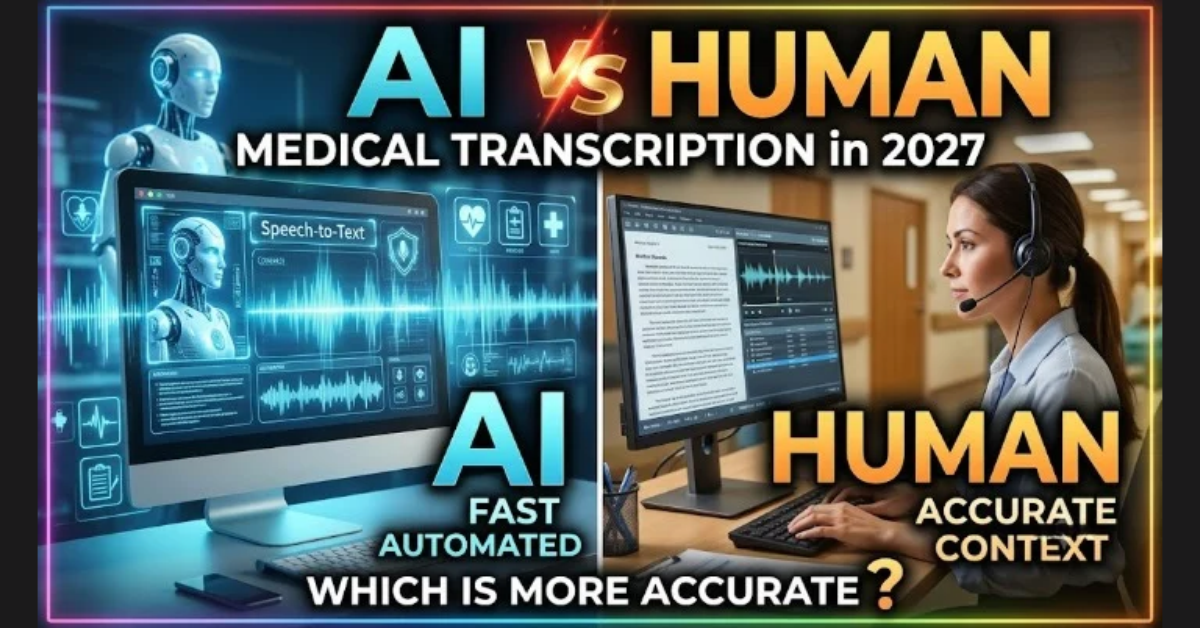
So, is human transcription more accurate than AI transcription? In complex or business-critical situations, human transcription and human-reviewed workflows can provide an important accuracy advantage because trained transcribers can interpret context, distinguish speakers, recognize specialized terminology, and resolve ambiguities that automated systems may misunderstand.
At myTranscriptionPlace, we combine technology with human expertise to help organizations obtain accurate, professionally reviewed transcripts while maintaining practical turnaround times.
Quick Answer: Is Human Transcription More Accurate Than AI?
Human transcription is generally better suited to complex recordings where context and precision are important. Trained transcribers can account for accents, unclear speech, multiple speakers, overlapping conversations, industry-specific terminology, and contextual meaning.
AI transcription is usually faster and can be highly useful for clear recordings, first drafts, searchable notes, and situations where occasional errors can be corrected later.
For organizations that need both efficiency and quality control, hybrid transcription combines AI-generated transcripts with human review and correction.
The right choice therefore depends less on whether AI or humans are inherently "better" and more on the quality of the recording, complexity of the content, acceptable error level, and intended use of the transcript.
Human vs. AI vs. Hybrid Transcription: What's the Difference?
The three approaches serve different purposes.
What Does Transcription Accuracy Actually Mean?
Transcription accuracy is more than correctly converting individual sounds into words.
A high-quality transcript should accurately represent the original recording, including relevant terminology, speaker identification, wording, and contextual meaning.
Depending on the project, transcription accuracy can involve:
Correct words and phrases
Accurate speaker identification
Proper names and company names
Medical, legal, academic, or technical terminology
Recognition of accents and dialects
Correct handling of unclear speech
Appropriate treatment of overlapping speakers
Meaningful punctuation and formatting
Accurate timestamps when required
Correct identification of inaudible sections
This is why a transcript can appear grammatically correct while still containing important errors. A wrongly interpreted word may look perfectly natural in a sentence but completely change the meaning of what the speaker intended.
Why Does Transcription Accuracy Matter More Than Speed?
A fast transcript is only useful if it contains the information you need.
Consider a researcher analyzing interviews with customers. If one important response is transcribed incorrectly, the researcher could draw the wrong conclusion from the interview data.
The consequences can be even more significant when transcripts contain:
Medical terminology
Legal discussions
Research findings
Financial information
Business decisions
Sensitive interviews
Expert testimony
Academic research
Regulatory or compliance-related information
AI transcription can produce a transcript quickly, but speed does not eliminate the need to evaluate the output.
When accuracy matters, the transcript may need to be reviewed for terminology, speaker attribution, context, unclear passages, and other potential errors.
When Is AI Transcription Good Enough?
AI transcription can be an excellent choice when the consequences of minor errors are low and the recording is relatively straightforward.
Automated transcription may work well for:
Personal notes
Brainstorming sessions
Clear one-speaker recordings
Internal meetings
Draft interviews
Searchable audio archives
Content discovery
First drafts
Recordings that will receive human editing later
For these situations, the primary benefit of AI is speed and scalability.
If a transcript is being used only as a starting point, an AI-generated draft can save substantial time.
The important question is not simply, "Can AI transcribe this recording?" It is:
"How accurate does the final transcript need to be?"
When Should You Choose Human Transcription?
Human transcription becomes particularly valuable when the recording is difficult, specialized, sensitive, or important enough that errors could have significant consequences.
Human transcription may be preferable when:
Several people are speaking
Speakers interrupt one another
The recording contains strong accents or dialects
Background noise affects the audio
Speakers talk quickly or unclearly
Industry-specific terminology is used
Medical or legal terminology is involved
Speaker identification is important
The transcript will support academic or market research
The transcript will be published
Accuracy is more important than turnaround time
A trained transcriber does not simply listen for individual words. They can use the surrounding conversation to determine what a speaker most likely intended and identify sections that require additional attention.
Where Does AI Transcription Fall Short?
Automated speech recognition has improved considerably, but transcription difficulty varies significantly from one recording to another.
Accents and Dialects
Pronunciation can vary considerably between speakers. Regional accents, dialects, and non-native pronunciation can make automated speech recognition less reliable.
A human transcriber can use context and the rest of the conversation to interpret unfamiliar pronunciation.
Background Noise
Recordings made in offices, conferences, restaurants, vehicles, public spaces, or other noisy environments can contain competing sounds.
Background conversations, equipment noise, echoes, poor microphones, and interruptions can make certain words difficult for automated systems to recognize.
Multiple Speakers
A conversation involving several speakers presents another challenge.
A useful transcript may need to identify who said each statement and maintain consistent speaker labels throughout the recording.
Human transcribers can listen for changes in voice, conversational context, and turn-taking to help distinguish speakers.
Overlapping Speech
People do not always take turns speaking neatly.
Interviews, focus groups, meetings, and discussions may contain interruptions, simultaneous speech, incomplete sentences, and people talking over one another.
These situations can be difficult for automated systems and may require human interpretation and review.
Specialized Terminology
Medical, legal, scientific, technical, and business recordings can contain terminology that is uncommon in everyday speech.
A transcription system may produce a plausible-looking word that is incorrect for the context.
Human review can help identify and correct terminology based on the surrounding conversation and subject matter.
How Do Human Transcribers Handle Difficult Audio?
Human transcription is particularly valuable because a trained transcriber can evaluate the recording as a whole rather than treating each spoken phrase as an isolated sound sequence.
Depending on the project, human review can include:
Listening carefully to the recording.
Identifying speakers and maintaining speaker labels.
Reviewing unclear or ambiguous sections.
Checking terminology and proper names.
Considering the context of the conversation.
Marking inaudible sections appropriately.
Reviewing overlapping speech and interruptions.
Correcting errors in the initial transcript.
Checking formatting and consistency.
Performing a final quality review before delivery.
This process is especially useful when a transcript will become part of research, professional documentation, published content, or an important business record.
Why Does Medical Transcription Still Require Human Review?
Medical transcription requires particular attention because clinical conversations can contain specialized terminology, abbreviations, medication names, diagnoses, anatomical terms, and other information where a transcription error may materially change the written record.
For example, medical recordings may include:
Drug and medication names
Dosages
Medical abbreviations
Anatomical terminology
Diagnoses
Clinical observations
Physician and patient names
Specialist terminology
Multiple speakers
Accented or unclear speech
AI can assist with the initial speech-to-text process, but professional medical transcription should involve appropriate human review when accuracy and contextual interpretation are important.
Human reviewers can check terminology, identify questionable wording, and flag unclear sections rather than simply accepting an automated transcript at face value.
For sensitive professional work, organizations should also consider their applicable privacy, confidentiality, security, and regulatory requirements when selecting a transcription workflow.
Human vs. AI Transcription: Speed, Cost and Accuracy
The decision between AI and human transcription is often a trade-off between speed, cost, complexity, and the acceptable level of error.
AI Transcription
AI transcription generally offers:
Very fast processing
Scalability for large volumes
Lower initial processing costs in many workflows
Convenient searchable text
Useful first drafts
Its limitations become more important when recordings are difficult or when errors have significant consequences.
Human Transcription
Human transcription generally offers:
Contextual interpretation
Human speaker identification
Better handling of difficult conversations
Attention to specialized terminology
Human judgment when audio is ambiguous
Additional quality control
The trade-off is that human transcription typically requires more processing time and resources.
Hybrid Transcription
Hybrid transcription combines the two approaches.
AI creates the initial transcript quickly, while human transcribers or reviewers check, correct, and refine the output.
For many organizations, this provides a practical balance between speed, scalability, and quality control.
What Is Hybrid Transcription?
Hybrid transcription combines automated speech-to-text technology with human review.
In a typical hybrid workflow:
AI processes the recording and creates an initial transcript.
A human reviewer examines the transcript against the original audio.
Errors are corrected.
Speakers and terminology are checked.
Ambiguous sections are reviewed.
Formatting and consistency are improved.
The final transcript is quality-checked before delivery.
Hybrid transcription can be particularly useful for organizations that handle a large volume of recordings but still require reliable final transcripts.
It avoids treating AI and human transcription as competing technologies. Instead, each is used for what it does best.
Which Transcription Method Should You Choose?
The simplest way to decide is to consider the recording and the consequences of errors.
Choose AI transcription when:
You need a transcript quickly.
The audio is clear.
There is limited background noise.
The recording has relatively straightforward speech.
You mainly need a searchable draft.
Minor errors can be corrected later.
Choose human transcription when:
Accuracy is critical.
The recording contains difficult accents.
Several people are speaking.
Speakers overlap or interrupt one another.
The content contains specialized terminology.
The transcript will be used for research or professional purposes.
Errors could affect important decisions.
You need human interpretation of ambiguous audio.
Choose hybrid transcription when:
You need both speed and quality control.
You process large volumes of recordings.
AI can efficiently create the first draft.
Human review is required before the transcript is considered final.
Different recordings in the same project have different levels of complexity.
How Does myTranscriptionPlace Approach Transcription Accuracy?
At myTranscriptionPlace, we do not view technology and human expertise as competing approaches.
Our workflow combines technology with professional transcription expertise to help clients manage transcription projects efficiently while maintaining human quality control.
Our network includes more than 50,000 native transcribers, supporting transcription projects across areas such as research, healthcare, legal, academic, business, media, and other specialized fields.
Depending on project requirements, our workflow can include:
Audio assessment
Appropriate transcriber selection
Transcription
Speaker identification
Terminology and context review
Quality checking
Peer review
Final formatting and delivery
Our stated service information includes a 99% accuracy commitment and a money-back accuracy guarantee, subject to the applicable service terms.
For organizations choosing a transcription provider, it is important to look beyond a headline accuracy percentage and understand how accuracy is defined, measured, reviewed, and guaranteed.
Human Transcription Is Not About Rejecting AI
The future of transcription does not necessarily require choosing between humans and technology.
AI has made transcription dramatically faster and more scalable. That is a genuine advantage.
The question is where automation should end and human judgment should begin.
For straightforward recordings, AI can provide an efficient transcript or first draft. For difficult, specialized, or high-consequence recordings, human review can provide an additional layer of accuracy and contextual understanding.
A hybrid approach can combine the strengths of both.
At myTranscriptionPlace, our goal is to use technology where it improves efficiency while retaining human expertise where accuracy, context, and specialized knowledge matter.
Final Takeaway: Accuracy Should Match the Purpose of the Transcript
AI transcription has made speech-to-text faster, more accessible, and easier to scale. For clear and relatively simple recordings, automated transcription can be an effective solution for drafts, notes, and searchable content.
But when context matters, accuracy becomes more important than simply producing text quickly.
Accents, background noise, multiple speakers, overlapping conversations, specialized terminology, and sensitive professional content can all increase the risk of transcription errors.
Human transcription remains valuable because trained professionals can listen to the recording in context, recognize ambiguity, verify terminology, and review the transcript before it becomes a final document.
For organizations that need both efficiency and quality control, hybrid transcription offers another option by combining AI's processing speed with human review.
At myTranscriptionPlace, we believe the most effective approach is not humans versus AI. It is using technology for efficiency and human expertise for accuracy, context, and quality control.
Our Best Translation Services
English to Indonesian Translation | English to Spanish Translation | English to Italian Translation | English to Russian Translation | English to Danish Translation | English to Vietnamese Translation | English to Japanese Translation | English to Finnish Translation | English to Dutch Translation | English to Arabic Translation | English to Norwegian Translation | English to Greek Translation.
Frequently Asked Questions
1. Is human transcription more accurate than AI transcription?
For complex recordings, human transcription can provide stronger accuracy because trained transcribers can interpret context, accents, multiple speakers, overlapping speech, and specialized terminology. AI transcription is highly useful for speed and first drafts, particularly when the recording is clear and straightforward.2. Is AI transcription accurate enough for interviews?
It can be, particularly when interviews have clear audio, limited background noise, and distinct speakers. However, research and professional interviews may contain accents, incomplete sentences, industry terminology, interruptions, and overlapping speech. When the transcript will influence research findings or important decisions, human review can provide an additional quality layer.3. When should I use human transcription instead of AI?
Human transcription is worth considering when accuracy is critical, the recording is difficult to understand, several speakers are involved, terminology is specialized, or the transcript will be used for professional, legal, medical, academic, research, or business-critical purposes.4. Why does AI transcription make mistakes?
Automated transcription systems can have difficulty with background noise, accents, unclear speech, overlapping speakers, rapid speech, unusual terminology, names, and other conditions that make spoken language difficult to interpret. A resulting sentence may look plausible even when one or more words have been transcribed incorrectly.5. Can AI accurately transcribe medical recordings?
AI can assist with medical transcription, particularly as an initial speech-to-text tool. However, medical recordings can contain specialized terminology, medication names, abbreviations, and clinically important details. Professional medical transcription workflows should include appropriate human review when accuracy and contextual interpretation are important.6. Can AI transcription identify multiple speakers?
Some AI transcription systems can identify or separate speakers, but accuracy can vary depending on audio quality, the number of speakers, voice similarity, interruptions, and overlapping speech. Human review can help correct speaker attribution when accurate speaker identification is important.7. Is human transcription worth the extra cost?
It depends on the purpose of the transcript. If you only need a quick draft or searchable notes, AI may be sufficient. If errors could affect research findings, professional documentation, medical information, legal work, published content, or business decisions, the additional quality control provided by human transcription or human-reviewed transcription may justify the cost.8. What is hybrid transcription?
Hybrid transcription combines AI-generated speech-to-text with human review. AI produces an initial transcript quickly, while human transcribers or reviewers check the recording, correct errors, verify context and terminology, and prepare the final transcript.9. What factors affect transcription accuracy?
Important factors include audio quality, background noise, speaker accents, number of speakers, overlapping speech, speaking speed, terminology, microphone quality, recording environment, and the complexity of the conversation.10. How can I improve the accuracy of an AI-generated transcript?
Use high-quality audio whenever possible, minimize background noise, record speakers clearly, identify speakers when possible, and review the transcript against the original recording. For specialized or business-critical content, professional human review can provide an additional layer of quality control.
Nishi Singh
(Content Writer & SEO Manager)
She is an SEO Manager with over 8 years of experience in marketing and content creation. She specializes in SEO, content strategy, and paid advertisements, helping website owners across SaaS, B2B businesses, and e-commerce platforms achieve measurable growth. With a strong focus on driving organic traffic and crafting impactful content, Nishi has established herself as a trusted expert in the digital marketing space. When she's not optimizing websites, she channels her energy into marathon running, embracing challenges both on and off the track.