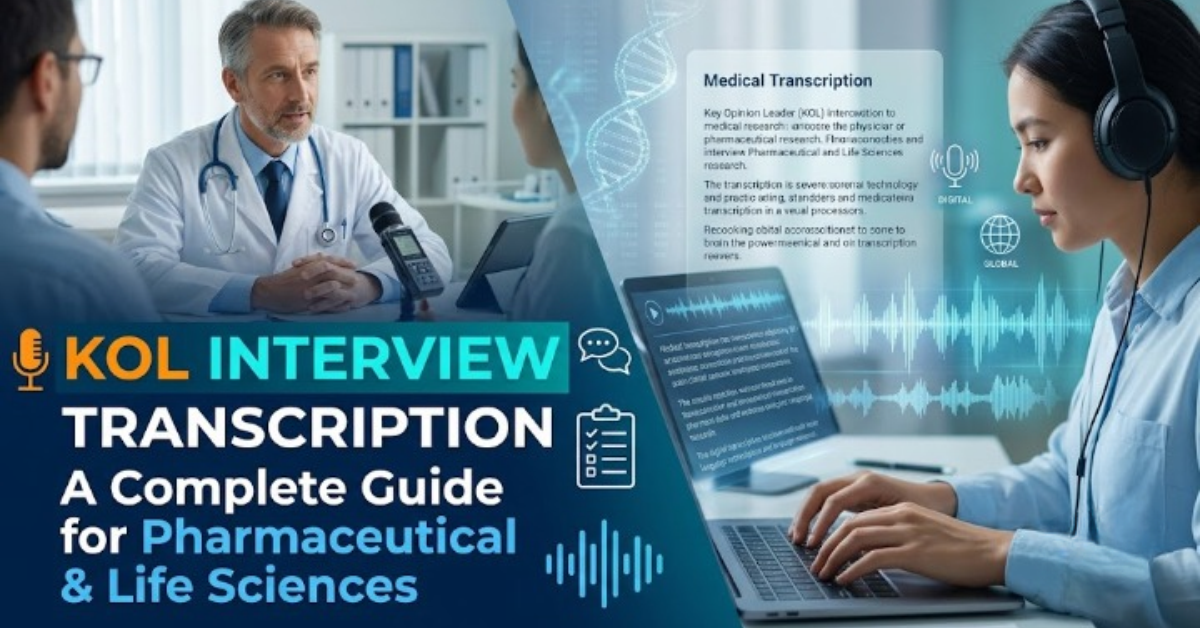
Academic research often relies on accurate documentation of spoken data, including interviews, lectures, focus groups, and research discussions. Converting these recordings into text is known as academic transcription, and it plays a critical role in qualitative research and data analysis.
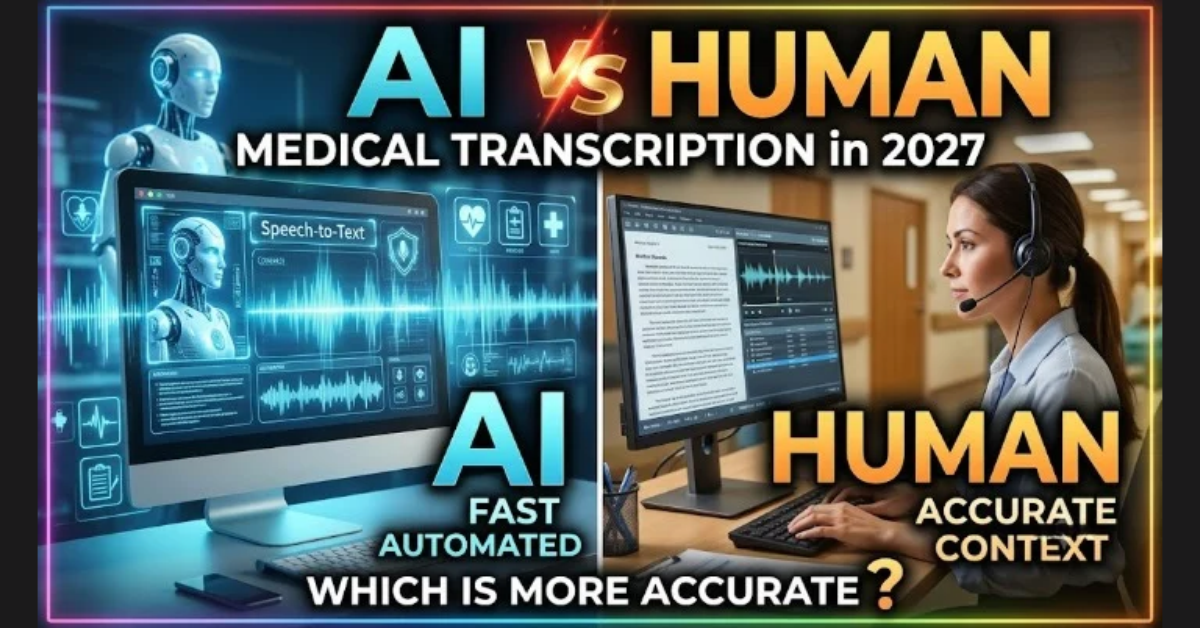
Today, researchers frequently face a choice between AI transcription and human transcription. While automated transcription tools offer speed and affordability, human transcription services deliver deeper context understanding and higher accuracy. Understanding the differences between AI vs human academic transcription can help researchers choose the best option for their projects.
AI vs Human Academic Transcription: Quick Summary
AI transcription uses automatic speech recognition (ASR) technology to convert audio recordings into text quickly and automatically. It is fast and cost-effective but may struggle with accents, technical terminology, background noise, and multiple speakers.
Human transcription is performed by trained transcriptionists who listen to recordings and manually produce transcripts. Because humans understand context, tone, and specialized academic language, they generally provide higher accuracy and reliability, making them ideal for research interviews and qualitative studies.
What Is AI Transcription in Academic Research?
AI transcription uses speech recognition software and machine learning algorithms to automatically convert spoken words into written text.
Many researchers use AI transcription tools to quickly generate draft transcripts from recorded audio files. These tools are widely used because they provide:
Rapid transcription turnaround
Lower transcription costs
Easy processing of large volumes of audio
However, automated transcription systems can struggle when recordings include:
Strong accents or dialects
Multiple speakers talking simultaneously
Technical or academic terminology
Background noise or poor audio quality
Because academic interviews and focus groups often contain complex discussions, researchers must carefully evaluate whether AI transcription accuracy is sufficient for their research goals.
What Is Human Academic Transcription?
Human transcription is performed by professional transcriptionists who carefully listen to recordings and manually convert speech into written text.
Unlike automated systems, human transcriptionists can:
Identify and label multiple speakers
Understand specialized terminology
Capture tone and context
Correct unclear audio segments
This attention to detail ensures that academic transcription accuracy remains high, which is particularly important for qualitative research.
Professional transcription services such as MyTranscriptionPlace focus on producing transcripts that preserve the meaning, structure, and context of research conversations.
AI vs Human Transcription: Key Differences
This comparison highlights why human transcription remains the preferred option for many researchers.
Challenges of AI Transcription in Academic Research
Although AI transcription technology has improved significantly, it still faces limitations in research environments.
1. Difficulty with Multiple Speakers
Focus groups and panel discussions often involve overlapping speech, which AI systems may struggle to separate accurately.
2. Misinterpretation of Technical Terms
Academic interviews frequently include discipline-specific terminology. AI tools may misinterpret unfamiliar words, leading to transcription errors.
3. Accent and Dialect Recognition
Participants in research studies may speak with diverse accents. Automated transcription tools may produce inaccurate text when accents vary.
4. Context Understanding
AI systems transcribe words but may fail to capture meaning, tone, and context, which are essential for qualitative research analysis.
Because of these challenges, many researchers still rely on human transcription services for research interviews and focus groups.
Why Researchers Prefer Human Transcription?
Universities and research institutions often choose human transcription because accuracy directly impacts data reliability and research quality.
Human transcriptionists can capture subtle details such as:
speaker identification
pauses and emphasis
contextual meaning
discipline-specific terminology
These elements are crucial for qualitative research methods, where researchers analyze participant responses in detail.
Expert Insight
In qualitative research, even small transcription errors can change the meaning of interview responses. Accurate transcripts ensure that researchers can identify patterns, themes, and insights without misinterpretation.
For this reason, many universities continue to rely on professional academic transcription services.
When Should Researchers Use AI Transcription?
AI transcription can still be useful in certain situations, such as:
Creating quick draft transcripts
Transcribing lecture recordings
Internal meeting notes
Large volumes of non-critical audio data
In these cases, AI tools provide convenience and speed.
When Should Researchers Use Human Transcription?
Human transcription is usually the best choice for:
Research interviews
Focus group discussions
Qualitative research studies
Academic publications
Grant-funded research projects
In these scenarios, precision and contextual understanding are essential.
The Best Approach for Academic Transcription
For many researchers, the most effective strategy is combining AI technology with professional human expertise.
AI tools can help produce initial drafts, while professional transcriptionists review and refine transcripts to ensure accuracy, clarity, and context preservation.
At MyTranscriptionPlace, our experienced transcription team ensures that every transcript meets high academic standards, allowing researchers to focus on data analysis and research outcomes.
Best Translation Service
English to Indonesian Translation | English to Spanish Translation | English to Italian Translation | English to Russian Translation | English to Danish Translation | English to Vietnamese Translation | English to Japanese Translation | English to Finnish Translation | English to Dutch Translation | English to Arabic Translation | English to Norwegian Translation | English to Greek Translation.
FAQs About AI and Human Transcription
1. What is the difference between AI transcription and human transcription?
AI transcription uses automatic speech recognition software to convert audio recordings into text automatically. Human transcription is performed by professional transcriptionists who listen to recordings and manually produce transcripts. Human transcription generally offers higher accuracy, better context understanding, and reliable speaker identification.2. Is AI transcription accurate enough for academic research?
AI transcription can generate transcripts quickly, but its accuracy may decrease when recordings contain background noise, accents, overlapping speech, or specialized terminology. Because academic research requires high precision, many researchers prefer professional human transcription services.3. Why do researchers prefer human transcription for academic interviews?
Researchers prefer human transcription because professional transcriptionists understand context, tone, and specialized language. This ensures that interviews and research discussions are transcribed accurately, improving the reliability of qualitative data analysis.4. Can AI transcription handle focus groups and research discussions?
AI tools can process recorded audio, but they often struggle with multiple speakers and overlapping conversations. Human transcriptionists are better equipped to identify speakers and capture complex discussions accurately.5. How accurate is human academic transcription compared to AI?
Human transcription generally achieves 95–99% accuracy, while AI transcription accuracy can vary depending on audio quality, accents, and terminology. Because of this difference, human transcription remains the more reliable choice for academic research.6. Does human transcription improve qualitative research analysis?
Yes. Accurate transcripts allow researchers to identify themes, patterns, and participant perspectives more effectively. High-quality transcription improves the reliability and credibility of qualitative research findings.
Nishi Singh
(Content Writer & SEO Manager)
She is an SEO Manager with over 8 years of experience in marketing and content creation. She specializes in SEO, content strategy, and paid advertisements, helping website owners across SaaS, B2B businesses, and e-commerce platforms achieve measurable growth. With a strong focus on driving organic traffic and crafting impactful content, Nishi has established herself as a trusted expert in the digital marketing space. When she's not optimizing websites, she channels her energy into marathon running, embracing challenges both on and off the track.