Clinical trials often involve participants, investigators, healthcare professionals, and research teams who speak different languages. When study participants speak Spanish, accurate translation of clinical trial documents is essential for communicating study information clearly and consistently.
Spanish clinical trial translation is the process of translating clinical research documents and participant-facing materials into Spanish while preserving the source content's medical meaning, intent, and relevant context. Depending on the document and study requirements, the process may include specialist translation, independent review, terminology checks, quality assurance, and linguistic validation.
For clinical trial sponsors and Contract Research Organizations (CROs), a well-planned translation workflow can support participant understanding, consistent study communication, and effective coordination across multilingual research sites.
MyTranscriptionPlace provides language services for clients with multilingual communication needs. The appropriate translation and review process should be determined by the document type, target population, study requirements, and applicable local requirements.
Why Is Spanish Clinical Trial Translation Important?
Spanish clinical trial translation helps participants understand study information in their preferred language and enables research teams to communicate study requirements more consistently.
Clinical trial documents may contain complex medical terminology, detailed procedures, potential risks, and information about participant rights. If these details are translated inaccurately or expressed unclearly, readers may misunderstand important aspects of the study.
Accurate translation supports several important objectives:
Participant understanding: Clearly communicate the study purpose, procedures, potential risks, anticipated benefits, and participation requirements.
Informed decision-making: Help prospective participants understand the information they need to consider before deciding whether to participate.
Consistent study communication: Maintain consistent terminology and meaning across relevant documents and research sites.
Reliable data collection: Help participants understand questionnaires, symptom diaries, and other study-related instructions.
Study coordination: Support communication between sponsors, CROs, investigators, and other stakeholders working with Spanish-language materials.
Translation alone does not guarantee regulatory compliance or participant comprehension. The documents must also be appropriate for the intended audience, reviewed according to the study's quality procedures, and handled in accordance with applicable ethical and regulatory requirements.
Which Clinical Trial Documents Need Spanish Translation?
The clinical trial documents requiring Spanish translation depend on the study design, participant population, locations, and applicable requirements. Materials intended for participants often need particular attention to readability and cultural appropriateness, while technical documents require precise scientific terminology.
Common document categories include:
1. Informed Consent Forms and Participant Information Sheets
These documents explain the study purpose, procedures, foreseeable risks, potential benefits, alternatives where applicable, confidentiality, and participants' rights. Translations should preserve the source meaning while using language appropriate for the intended population.
2. Clinical Trial Protocols and Study Documentation
Protocols describe the study objectives, design, methodology, treatment plan, and procedures. Related documentation may require specialist terminology management to maintain consistency across the translated materials.
3. Patient Questionnaires and Clinical Outcome Assessments
Patient-reported outcome measures, symptom questionnaires, quality-of-life instruments, and other clinical outcome assessments may require specialized translation and linguistic validation. The appropriate methodology depends on the instrument, its intended use, and the study requirements.
4. Patient Diaries and Study Instructions
Participants may need to record symptoms, medication use, treatment experiences, or other study-related information. Clear instructions help them understand what to record, when to complete an entry, and how to follow the study procedures.
5. Recruitment and Participant-Facing Materials
Recruitment advertisements, study summaries, invitation letters, and participant information materials may need translation to communicate the study to the intended audience. Their content should remain consistent with approved study information and applicable requirements.
6. Safety Reporting and Adverse Event Instructions
Participants may receive instructions about recognizing and reporting symptoms or other medical concerns during a study. These materials require particular care to preserve the meaning of the source instructions and avoid ambiguity.
7. Digital Clinical Trial Materials
Electronic questionnaires, eConsent interfaces, patient portals, mobile applications, and other digital study materials may also require Spanish localization. Translation should account for interface constraints, usability, and consistency between digital and supporting documents.
Before starting a project, sponsors and CROs should identify the documents required, intended users, target locale, review expectations, and any applicable approval requirements.
Spanish Informed Consent Translation and Participant Safety
Spanish informed consent translation is a critical component of preparing participant-facing materials for clinical research involving Spanish-speaking populations.
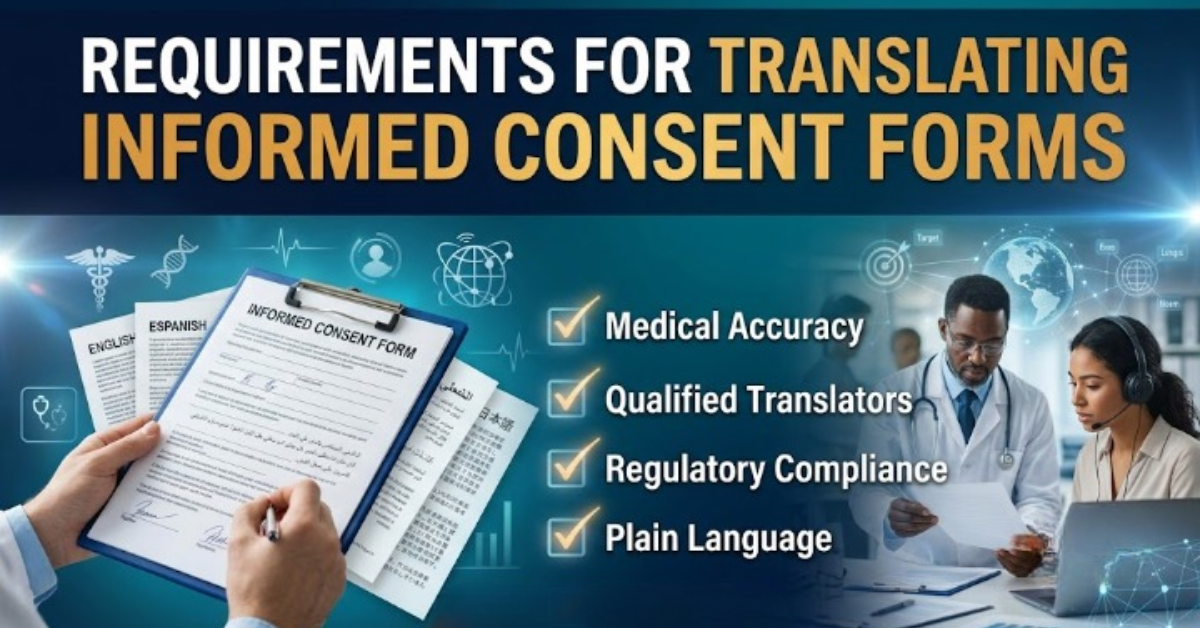
An informed consent form generally explains why a study is being conducted, what participation involves, potential risks and benefits, available alternatives where applicable, confidentiality considerations, and the participant's rights. The exact content depends on the study and applicable requirements.
A high-quality Spanish translation should preserve the source document's meaning without introducing omissions, unsupported explanations, or changes to important details.
Key considerations include:
Medical accuracy: Use appropriate Spanish medical terminology while preserving the meaning of the source text.
Plain language: Express complex concepts clearly for the intended participant population without changing their meaning.
Consistency: Use the same terms for recurring procedures, risks, treatments, and study concepts across related documents.
Cultural appropriateness: Identify wording that may be confusing, unfamiliar, or inappropriate for the intended Spanish-speaking population.
Quality review: Check the translated document against the source and follow the study's required review and approval process.
Simplifying language should never alter the meaning of a risk, procedure, participant right, or other material information. Any substantive clarification should be handled through the appropriate study review process.
Sponsors should also confirm whether translated consent materials require ethics committee or institutional review board review or approval before use. Translation is one part of the wider informed consent process; it does not replace the required participant discussion or consent procedures.
Medical Translation vs. Clinical Research Translation in Spanish
Medical translation and clinical research translation overlap, but they serve different purposes.
Medical translation covers a broad range of healthcare-related content, including medical records, discharge summaries, clinical reports, treatment instructions, and pharmaceutical documentation.
Clinical research translation focuses on documents and materials used in clinical studies, such as protocols, informed consent forms, participant questionnaires, clinical outcome assessments, and study-specific instructions.
Clinical research translation may require additional coordination because the same concepts and terms often appear across multiple documents, study phases, and research sites.
The right service depends on the document's purpose, audience, complexity, and required quality process. Not every clinical research document requires the same review methodology.
What Is Linguistic Validation in Clinical Trials?
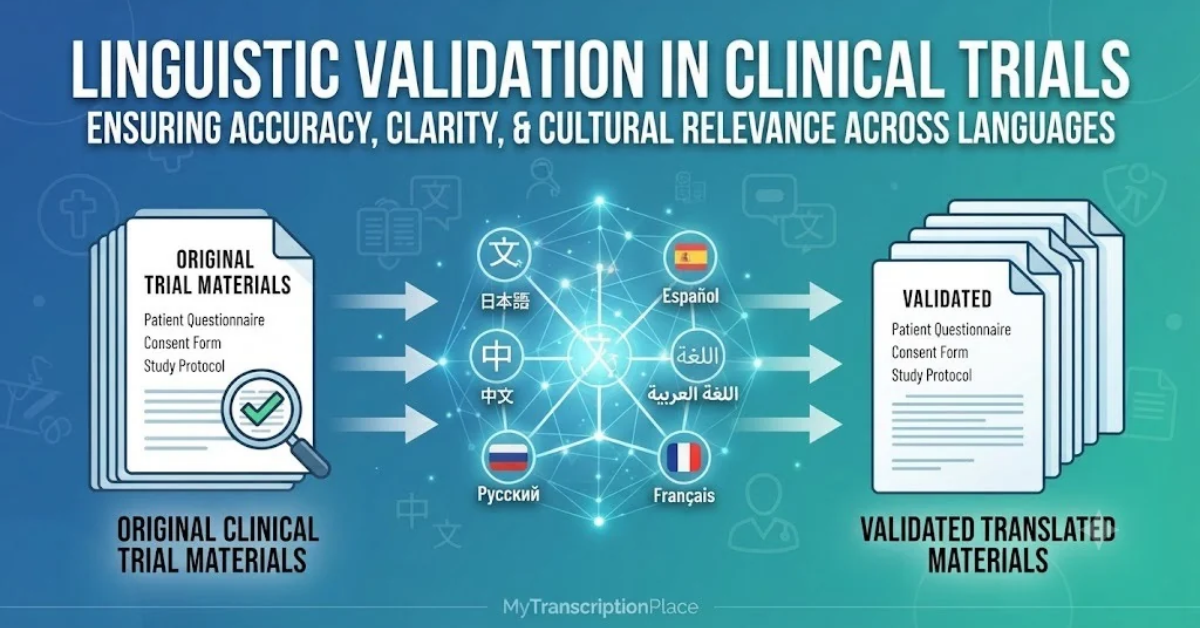
Linguistic validation is a process used to assess whether a translated instrument preserves the intended meaning of the source and is understandable and appropriate for its target population.
It is particularly relevant for patient-reported outcome measures, symptom questionnaires, quality-of-life instruments, and other tools used to collect information directly from participants.
Depending on the instrument and applicable methodology, the process may include:
Preparation: Review the source instrument, existing translations, intended population, and relevant terminology.
Forward translation: Translate the source into the target language using an appropriate specialist process.
Reconciliation or review: Compare translations and resolve differences to produce an agreed version.
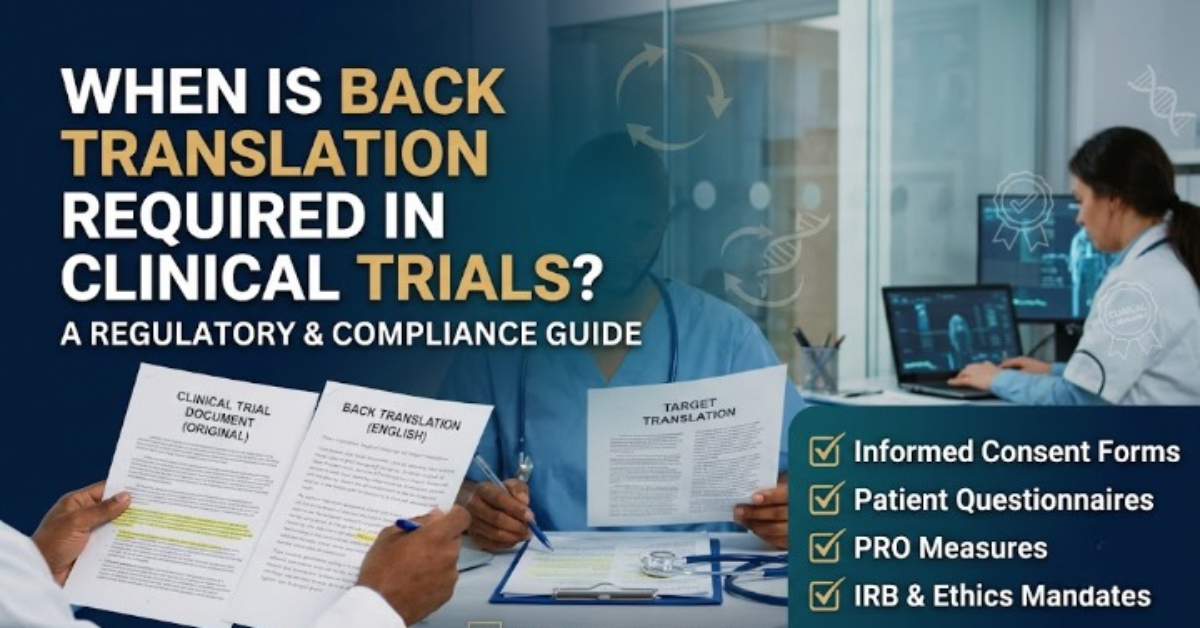
Back-translation, where required: Translate the target-language version back into the source language to help identify possible differences in meaning.
Cognitive debriefing or testing, where required: Assess whether members of the intended population understand the translated items as intended.
Final review and documentation: Address identified issues and document the decisions and approved version according to the applicable methodology.
The exact steps vary by instrument, study requirements, and the methodology specified by the relevant sponsor or instrument owner. Back-translation alone does not establish that a questionnaire is conceptually equivalent or suitable for its target population.
For sponsors and CROs, planning linguistic validation early is important because participant testing, review cycles, and instrument-owner approvals may affect project timelines.
How to Choose a Spanish Clinical Trial Translation Provider
Selecting a Spanish clinical trial translation provider involves more than comparing prices or turnaround times. Sponsors and CROs should assess whether a provider can meet the linguistic, technical, confidentiality, and project-management requirements of the study.
Consider the following criteria when evaluating a provider.
1. Clinical Research Experience
Ask about experience with the relevant document types, such as informed consent forms, clinical protocols, patient questionnaires, and clinical outcome assessments.
2. Qualified Translators and Reviewers
Understand how translators are selected, how their subject-matter expertise is assessed, and what independent review or quality checks are included.
3. Terminology Management
Ask how key medical and study-specific terms are maintained consistently across related documents, updates, and research sites.
4. Linguistic Validation Capabilities
If the project includes patient-reported outcome measures or other validated instruments, confirm that the proposed process matches the instrument's methodology and the study's requirements.
5. Quality Assurance and Documentation
Clarify how translations are checked, how revisions are managed, how issues are resolved, and what quality records can be provided.
6. Confidentiality and Data Security
Ask how sensitive clinical documents and participant-related information are handled, who can access the files, and what confidentiality and data-protection arrangements apply.
7. Project Management and Turnaround
Discuss document volumes, delivery milestones, review cycles, urgent requests, version control, and the process for incorporating sponsor or CRO feedback.
8. Transparent Scope and Pricing
Confirm what is included in the quotation, such as translation, editing, proofreading, desktop publishing, quality checks, linguistic validation, or additional review stages. These services are not interchangeable, so the scope should be clear before work begins.
A structured provider assessment helps sponsors and CROs match the translation workflow to the complexity of the study and the requirements of the documents.
Best Practices for Managing Spanish Clinical Trial Translation
A well-organized workflow can help reduce avoidable delays and inconsistencies.
Plan early: Identify translation needs during study planning rather than waiting until all documents are ready for deployment.
Confirm the target locale: Specify the intended Spanish-speaking population and whether regional terminology or adaptations are needed.
Provide reference materials: Share approved glossaries, existing translations, style guides, and relevant study context where available.
Maintain document version control: Ensure that translators and reviewers work from the correct source files and that changes are tracked.
Define review responsibilities: Establish who will review linguistic accuracy, scientific content, and study-specific requirements.
Allow time for validation: Account for any cognitive debriefing, instrument-owner review, ethics committee review, or other required approval steps.
Protect confidential information: Use appropriate access controls and secure file-transfer processes for sensitive study materials.
These practices help project teams coordinate multilingual documentation more effectively while keeping the process aligned with the study's requirements.
Conclusion
Spanish clinical trial translation helps sponsors and Contract Research Organizations communicate study information accurately to Spanish-speaking participants and research teams. From informed consent forms and study protocols to patient questionnaires and digital materials, each document requires an approach suited to its purpose and audience.
A reliable workflow should consider specialist translation, consistent terminology, appropriate quality review, confidentiality, and any required linguistic validation or study approvals.
By planning early, defining document requirements, and selecting a provider with the appropriate expertise and quality processes, clinical research teams can manage multilingual study materials more effectively.
MyTranscriptionPlace supports clients with language-service needs. Sponsors and CROs should define their specific document scope, target population, review requirements, and timelines before selecting the appropriate translation workflow.
Popular Searches
English to Spanish Translation Services | Spanish Translation Services | Automatic Spanish to English transcription | Top Tools for Spanish Transcription | Spanish Audio Transcription | Spanish Simultaneous Interpretation & Consecutive Interpretation | Spanish Translation vs Machine Translation | Why Spanish Transcription services are crucial for global businesses?
Frequently Asked Questions
1. What is Spanish clinical trial translation?
Spanish clinical trial translation is the translation of clinical research documents and participant-facing materials into Spanish while preserving the source meaning, medical terminology, and study-specific information. Depending on the document, the process may include specialist review and quality assurance.
2. What clinical trial documents can be translated into Spanish?
Common examples include informed consent forms, participant information sheets, clinical trial protocols, patient questionnaires, clinical outcome assessments, patient diaries, recruitment materials, safety reporting instructions, and digital study content. Requirements vary by study and location.
3. What is linguistic validation in clinical trials?
Linguistic validation assesses whether a translated instrument preserves the intended meaning of the source and is understandable and appropriate for the target population. Depending on the methodology, it may include translation, reconciliation, back-translation, cognitive debriefing, and final review.
4. What is the difference between medical translation and clinical trial translation?
Medical translation covers a broad range of healthcare documents and communications. Clinical trial translation focuses on research-specific materials, such as study protocols, informed consent forms, questionnaires, and clinical outcome assessments, where consistent study terminology may be especially important.
5. How long does Spanish clinical trial translation take?
Turnaround depends on document length, complexity, file format, terminology requirements, review stages, and project volume. Linguistic validation or additional approval steps may require more time than translation and review alone. A provider should estimate the schedule after assessing the project scope.
6. Is linguistic validation required for every clinical trial document?
No. Linguistic validation is particularly relevant to certain instruments, such as patient-reported outcome measures, and depends on the instrument, intended use, and study requirements. Other documents may require specialist translation and appropriate quality review without the same validation process.
7. How do sponsors and CROs choose a Spanish clinical trial translation provider?
They should assess clinical research experience, translator qualifications, terminology management, review processes, confidentiality arrangements, project management, and the provider's ability to meet the study's specific requirements.

Nishi Singh
(Content Writer & SEO Manager)
She is an SEO Manager with over 8 years of experience in marketing and content creation. She specializes in SEO, content strategy, and paid advertisements, helping website owners across SaaS, B2B businesses, and e-commerce platforms achieve measurable growth. With a strong focus on driving organic traffic and crafting impactful content, Nishi has established herself as a trusted expert in the digital marketing space. When she's not optimizing websites, she channels her energy into marathon running, embracing challenges both on and off the track.