Quick Answer
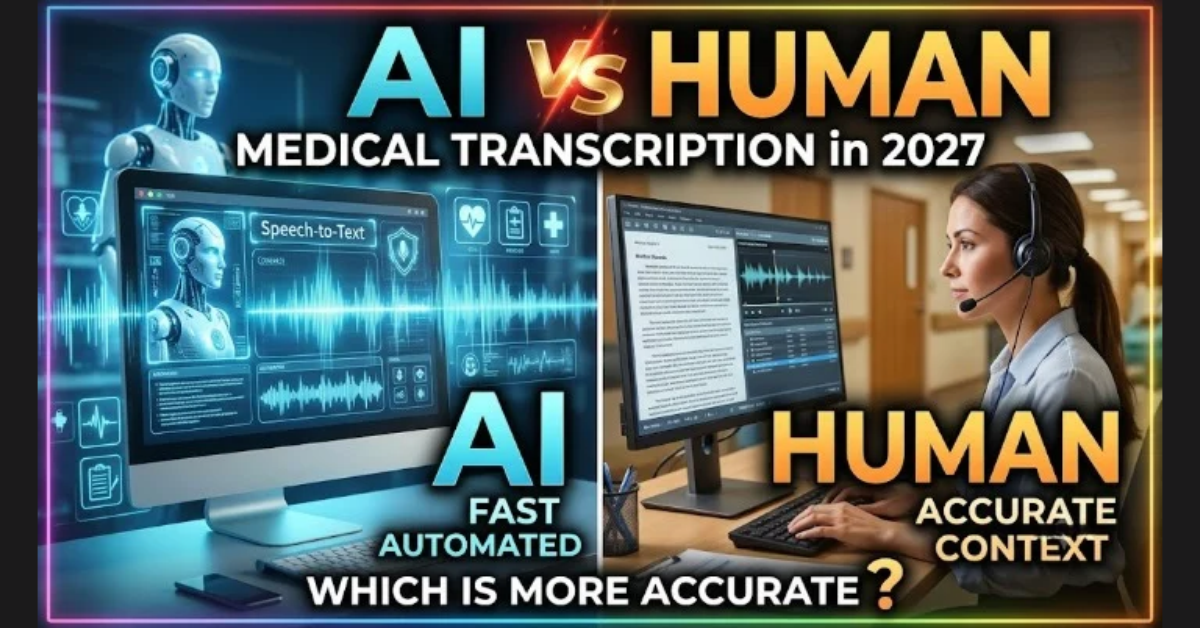
For most academic, healthcare, legal, and qualitative research projects, human transcription remains the most accurate and reliable option. Professional human transcriptionists understand context, accents, technical terminology, multiple speakers, and subtle nuances that automated transcription software often struggles to interpret accurately.
Automated transcription, however, offers significant advantages when speed and affordability are the priority. It is well suited for generating first drafts, transcribing internal meetings, or processing large volumes of audio where minor errors are acceptable.
The right choice ultimately depends on your project's objectives, required accuracy, turnaround time, confidentiality requirements, and budget.
Human vs Automated Transcription at a Glance
Why Transcription Quality Matters in Research?
Every research project depends on accurate data.
Whether you're conducting:
Academic interviews
Focus groups
Market research
Healthcare studies
Social science research
Legal investigations
Customer experience interviews
your conclusions are only as reliable as the information you analyze.
Researchers spend months designing studies, recruiting participants, collecting interviews, and analysing responses. Even small transcription errors can introduce inaccuracies during coding, thematic analysis, qualitative interpretation, or report writing.
An inaccurate transcript doesn't simply contain mistakes—it can change the meaning of participant responses and affect the validity of the research itself.
That's why choosing between human and automated transcription is an important methodological decision rather than simply an operational one.
Speed vs Accuracy: The Biggest Difference
One of the first questions researchers ask is:
"Should I prioritize speed or accuracy?"
Automated transcription systems use speech recognition technology to convert audio into text within minutes. A one-hour interview can often be processed in less than ten minutes.
This makes AI transcription attractive for:
Large datasets
Internal documentation
Preliminary transcript drafts
Projects with tight deadlines
However, fast transcription is not necessarily accurate transcription.
Research interviews often contain:
overlapping speakers
regional accents
specialist terminology
emotional responses
incomplete sentences
poor audio quality
interruptions
background conversations
These situations remain challenging for automated systems.
Professional human transcriptionists listen carefully, replay difficult sections, identify speakers correctly, understand context, and ensure the final transcript reflects what participants actually said rather than what software assumed they said.
For research projects where findings depend on accurate participant responses, this additional level of quality is invaluable.
Understanding Context Is Where Human Transcription Excels
Speech is rarely straightforward.
Participants often:
pause mid-sentence
change direction
use idioms
refer to previous comments
laugh
hesitate
correct themselves
Humans naturally interpret these patterns.
AI primarily predicts words based on statistical language models.
For example:
"I don't think the treatment worked..."
and
"I don't think... the treatment worked."
can convey different meanings depending on tone and pauses.
A skilled human transcriptionist recognises these subtle differences and preserves the intended meaning.
This contextual understanding becomes particularly important during:
qualitative analysis
thematic coding
discourse analysis
narrative research
phenomenological research
How Automated Transcription Performs in Complex Research Interviews
Not all recordings are created equal.
Many research interviews involve:
multiple participants
overlapping conversations
poor internet connections
conference recordings
telephone interviews
focus groups
field recordings
multilingual speakers
These conditions present significant challenges for speech recognition systems.
Common AI transcription issues include:
incorrect speaker labels
missing words
punctuation errors
misunderstood terminology
merged sentences
omitted sections
Professional transcriptionists can replay difficult audio multiple times and use contextual understanding to resolve ambiguous speech.
The result is a transcript that researchers can confidently analyse.
Human vs Automated Transcription Accuracy
Although accuracy varies depending on recording quality, one principle remains consistent:
Clear audio benefits both humans and AI, while poor audio widens the accuracy gap.
Factors affecting transcription accuracy include:
recording equipment
microphone quality
background noise
accents
speech clarity
technical vocabulary
number of speakers
For straightforward recordings, automated transcription can produce useful drafts.
For complex interviews, experienced human transcriptionists consistently provide higher-quality transcripts that require little or no correction.
Why Accuracy Directly Affects Research Findings?
Transcription is not simply converting speech into text.
It forms the foundation of research analysis.
Researchers frequently use transcripts for:
qualitative coding
thematic analysis
grounded theory
content analysis
discourse analysis
participant quotations
literature integration
Even seemingly minor transcription errors can influence:
coding consistency
theme development
interpretation
final conclusions
High-quality transcripts improve confidence in research findings and reduce time spent correcting errors during analysis.
Security and Confidentiality
Many research projects involve confidential information.
Examples include:
patient interviews
legal evidence
employee research
commercial studies
unpublished academic research
Before choosing any transcription solution, researchers should evaluate:
encryption standards
data retention policies
confidentiality agreements
access controls
compliance requirements
human review processes
Professional transcription providers typically implement strict confidentiality procedures designed to protect sensitive research data throughout the transcription process.
Cost vs Value
Automated transcription is generally less expensive.
However, researchers should also consider the hidden costs of correcting AI-generated transcripts.
If a researcher spends several hours editing an automated transcript, the apparent cost savings may quickly disappear.
Human transcription involves a higher initial investment but often reduces editing time while delivering a transcript that is ready for immediate analysis.
Which Transcription Method Should Researchers Choose?
Choose human transcription when your project requires:
qualitative research
academic publications
focus groups
healthcare interviews
legal documentation
accurate quotations
speaker identification
technical terminology
confidential information
Choose automated transcription when you need:
rapid turnaround
internal meeting notes
draft transcripts
large-scale recordings
lower costs
searchable text
Many modern research teams now combine both approaches by using automated transcription for an initial draft followed by professional human editing and quality assurance.
This hybrid workflow delivers both efficiency and research-grade accuracy.
Conclusion
There is no universal answer to the question of whether human or automated transcription is better.
The right solution depends on the goals of your research.
If speed is your highest priority and minor inaccuracies are acceptable, automated transcription offers an efficient starting point.
If your research depends on accurate participant quotations, nuanced interpretation, speaker identification, and reliable qualitative analysis, professional human transcription remains the gold standard.
Many researchers now combine AI efficiency with expert human review, achieving faster turnaround times without compromising data quality.
At myTranscriptionPlace, we combine experienced transcription professionals with modern transcription technology to deliver accurate, confidential, and research-ready transcripts that support reliable analysis and confident decision-making.
Our Best Translation Services
English to Indonesian Translation | English to Spanish Translation | English to Italian Translation | English to Russian Translation | English to Danish Translation | English to Vietnamese Translation | English to Japanese Translation | English to Finnish Translation | English to Dutch Translation | English to Arabic Translation | English to Norwegian Translation | English to Greek Translation
FAQs
1. Which is more accurate for research projects?
Human transcription generally provides the highest level of accuracy because trained transcriptionists understand context, accents, technical language, and speaker changes more effectively than automated software.2. Is automated transcription good enough for qualitative research?
Automated transcription can provide a useful starting point, but qualitative research often requires highly accurate transcripts. Most researchers benefit from human review before analysis begins.3. Can AI accurately identify multiple speakers?
Modern AI systems have improved speaker diarisation, but they may still struggle when participants interrupt one another, speak simultaneously, or have similar voices. Human transcription remains more reliable in these situations.4. Does transcription quality affect research outcomes?
Yes. Coding, thematic analysis, quotations, and final conclusions all depend on accurate transcripts. Errors during transcription can influence how researchers interpret participant responses.5. Is automated transcription secure?
Security depends on the provider. Researchers should always review data handling practices, encryption methods, confidentiality policies, and regulatory compliance before uploading sensitive recordings.6. Should researchers use a hybrid transcription workflow?
For many organisations, yes. Automated transcription can quickly produce an initial draft, while professional human editing ensures the final transcript meets research-quality standards.
Nishi Singh
(Content Writer & SEO Manager)
She is an SEO Manager with over 8 years of experience in marketing and content creation. She specializes in SEO, content strategy, and paid advertisements, helping website owners across SaaS, B2B businesses, and e-commerce platforms achieve measurable growth. With a strong focus on driving organic traffic and crafting impactful content, Nishi has established herself as a trusted expert in the digital marketing space. When she's not optimizing websites, she channels her energy into marathon running, embracing challenges both on and off the track.